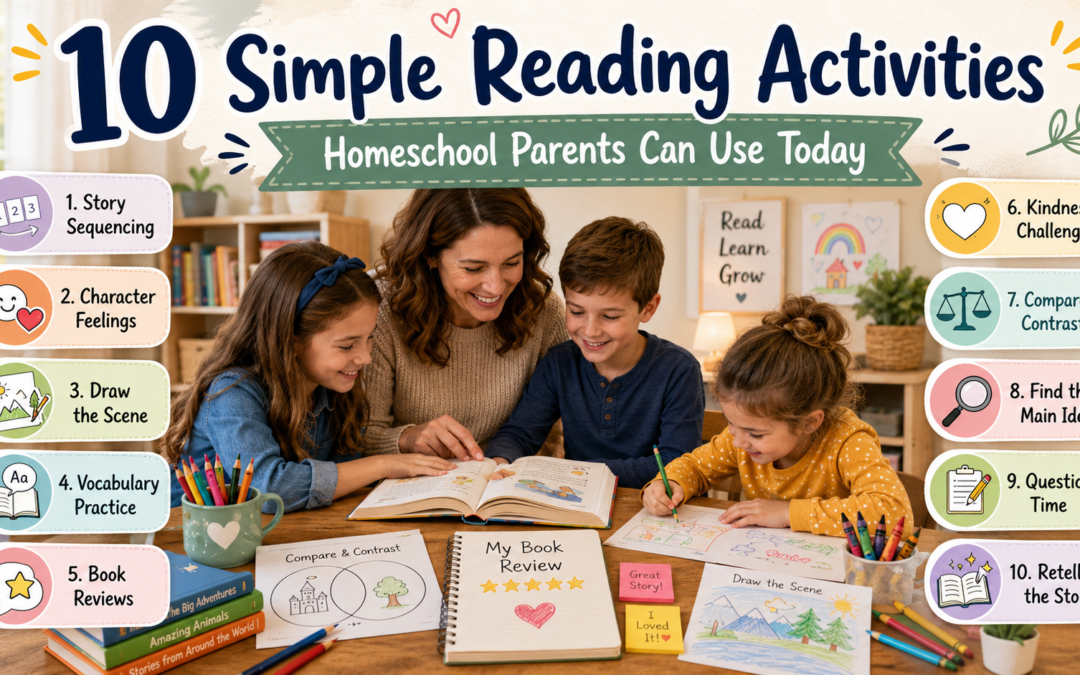
Reading at home does not have to end when the last page is turned. With a few simple activities, homeschool parents can help children understand stories more deeply, build reading skills, and connect lessons from books to everyday life. These activities are easy to use with almost any children’s book and can be adjusted for different ages.
1. Story Sequencing
After reading a story, ask your child to put the main events in order. This helps children remember what happened first, next, and last.
You can use three simple boxes labeled:
Beginning
Middle
End
Younger children can draw pictures for each part. Older children can write one or two sentences in each box. This activity builds comprehension, memory, and storytelling skills.
2. Character Feelings
Ask your child how a character felt during different parts of the story. For example:
How did the character feel at the beginning?
What made the character sad, excited, nervous, or proud?
How did the character’s feelings change by the end?
This helps children develop empathy and emotional understanding. It also teaches them to look for clues in the story, such as a character’s words, actions, and choices.
3. Draw the Scene
Children love responding to stories through art. Ask your child to draw their favorite scene from the book. Then have them explain what is happening in the picture.
You can add a short writing prompt under the drawing:
My favorite scene was when…
I liked this part because…
This activity is especially helpful for younger readers because it allows them to show understanding even if they are still developing writing skills.
4. Vocabulary Practice
Choose three to five words from the story. These can be new words, feeling words, action words, or descriptive words.
For each word, your child can:
Write the word
Say what it means
Use it in a sentence
Draw a picture of the word
For example, if the word is brave, a child might write:
Brave means doing something even when you feel nervous.
Vocabulary activities help children build stronger language skills and become more confident readers.
5. Book Review Page
A simple book review helps children think about what they read and form opinions.
Include questions such as:
What was the title of the book?
Who was your favorite character?
What was your favorite part?
What lesson did the story teach?
Would you recommend this book to a friend? Why or why not?
This activity encourages children to summarize, evaluate, and explain their thinking.
6. Kindness Challenge
Many children’s books include lessons about kindness, friendship, responsibility, courage, or helping others. After reading, invite your child to complete a kindness challenge inspired by the story.
Examples include:
Give someone a compliment
Help clean up without being asked
Invite someone to play
Make a thank-you card
Share a toy or book
Help a younger sibling
Then ask your child to write or draw what they did. This turns reading into real-life character building.
7. Compare-and-Contrast Page
Ask your child to compare two characters, two books, or two choices made in the story.
You can use a simple chart:
How are they alike?
How are they different?
For example, children might compare two characters and ask:
Who was more patient?
Who showed kindness?
Who learned the biggest lesson?
This activity builds critical thinking and helps children notice details.
8. Main Idea and Lesson
After finishing a book, ask your child:
What was the story mostly about?
What lesson did the character learn?
What did the story teach us?
Younger children can answer out loud. Older children can write a short paragraph. This activity helps children move beyond remembering events and begin understanding the message of the story.
9. Feelings and Choices Page
Stories give children a safe way to talk about decisions. Choose one moment when a character had to make a choice.
Ask:
What choice did the character make?
Was it a good choice? Why or why not?
What could the character have done differently?
What would you have done?
This activity helps children practice problem-solving, responsibility, and self-reflection.
10. Parent-Child Discussion Time
Sometimes the best reading activity is a simple conversation. After reading, spend a few minutes talking about the story together.
Try questions like:
What surprised you?
What made you smile?
Did the story remind you of anything in your life?
What did you learn from this book?
How can we use this lesson today?
These conversations strengthen reading comprehension while also building family connection.
Final Thought
Homeschool reading activities do not need to be complicated. A story sequencing page, a drawing activity, a few vocabulary words, or a short discussion can turn any book into a meaningful lesson. These simple activities help children become better readers, stronger thinkers, and more caring people.
Most importantly, they remind children that books are not just something to finish. Books are something to think about, talk about, learn from, and enjoy together.