
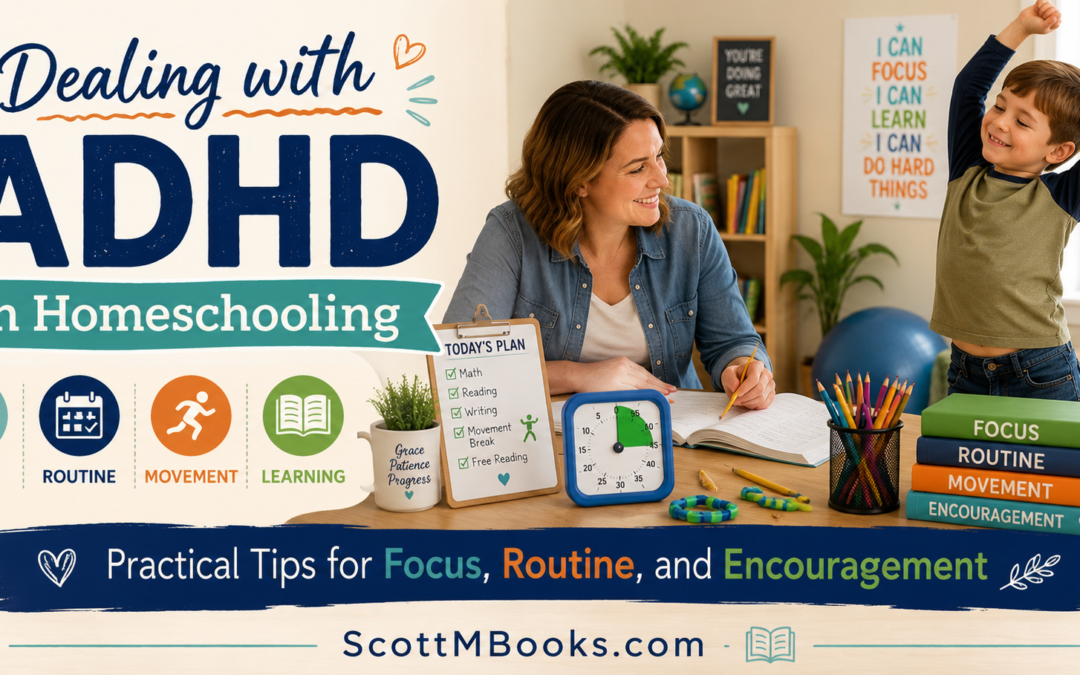
Homeschooling can be a wonderful option for children with ADHD because it allows families to create a learning environment that fits the child rather than forcing the child to fit into a single, rigid system. At home, parents can adjust the schedule, include movement, shorten lessons, use hands-on activities, and build in breaks when needed.
At the same time, homeschooling a child with ADHD can also feel challenging. Some days may include distractions, unfinished assignments, emotional frustration, restlessness, forgetfulness, or difficulty moving from one activity to the next. A parent may begin the day with a beautiful lesson plan and end the morning wondering why only one worksheet was completed.
The good news is that homeschooling does not have to look like a traditional classroom. For many children with ADHD, the most effective homeschool day is simple, structured, flexible, and full of encouragement.
Understanding ADHD in the Homeschool Day
ADHD can affect more than attention. It may also affect impulse control, organization, emotional regulation, memory, motivation, and the ability to begin or finish tasks. A child with ADHD may know the answer but struggle to sit still long enough to write it down. Another child may love stories but lose focus during long reading sessions. Some children may appear unmotivated when they are actually overwhelmed by too many steps.
This is important for homeschool parents to remember: ADHD is not laziness. It is not a character flaw. It is not a sign that your child cannot learn. It simply means your child may need learning presented in a different way.
Homeschooling gives you the freedom to ask, “How does my child learn best?” instead of “Why can’t my child do this like everyone else?”
Create a Predictable Routine
Children with ADHD often do better when they know what to expect. A predictable routine can lower stress because the child does not have to guess what comes next.
This does not mean every minute needs to be scheduled. In fact, overly strict schedules can create more frustration. Instead, try using a simple daily rhythm.
For example:
Morning basket or read-aloud time
Short math lesson
Movement break
Reading or phonics
Snack
Writing activity
Hands-on project
Outdoor time
A visual schedule can also help. Younger children may enjoy picture cards, while older children may prefer a checklist. The goal is to make the day feel clear and manageable.
When a child can see the plan, the day feels less overwhelming.
Keep Lessons Short and Focused
Many children with ADHD struggle with long lessons, even when they understand the material. Instead of expecting a child to sit for 45 minutes, try shorter learning blocks.
A 10- to 15-minute focused lesson may be far more effective than a long lesson filled with frustration. You can always return to the subject later in the day.
For example, instead of saying, “We are doing reading for one hour,” try:
“Let’s read two pages together.”
“Let’s answer three questions.”
“Let’s work for ten minutes, then take a break.”
Small goals help children feel successful. Success builds confidence. Confidence makes it easier to keep learning.
Use Movement as a Learning Tool
For many children with ADHD, movement is not a distraction from learning. Movement may be part of how they learn.
Instead of fighting constant movement, try using it wisely. Let your child stand while answering questions, bounce gently on an exercise ball, walk while reviewing spelling words, or act out scenes from a story. Some children focus better when their hands are busy with a quiet fidget item, drawing, or building with blocks while listening.
Movement breaks can also reset the brain. A child who cannot focus after twenty minutes of sitting may return refreshed after five minutes of jumping, stretching, walking outside, or doing a simple chore.
Homeschooling allows you to build movement into the day without embarrassment or punishment. That is one of its greatest strengths.
Break Assignments Into Smaller Steps
Children with ADHD may become overwhelmed when an assignment has too many parts. “Write a paragraph about the story” may sound simple to an adult, but to a child, it may feel like ten tasks at once.
Instead, break it down.
First, ask: “Who was the story about?”
Next: “What happened first?”
Then: “What was your favorite part?”
Finally: “Let’s put those ideas into three sentences.”
The same approach can work for math, chores, reading, projects, and writing assignments. Smaller steps make the work feel possible.
A helpful phrase is: “Let’s just do the next small thing.”
Built-in Choices
Children with ADHD often respond well when they have some control over the learning process. Too many choices can be overwhelming, but a few simple choices can reduce resistance.
You might ask:
“Do you want to read on the couch or at the table?”
“Do you want to write with a pencil or a marker?”
“Do you want to do math before reading or reading before math?”
“Do you want to answer these questions out loud or write them down?”
Choices help children feel respected. They also teach responsibility and decision-making.
Use Stories to Teach Focus, Feelings, and Choices
Books can be especially helpful for homeschool children with ADHD because stories allow children to learn through characters, emotions, and real-life situations. A child may not want a lecture about patience, kindness, responsibility, or self-control, but they may understand those lessons through a character’s experience.
After reading a story, parents can ask simple questions such as:
“How did the character feel?”
“What choice did the character make?”
“What could the character have done differently?”
“Have you ever felt that way?”
“What is one kind choice we can make today?”
This turns reading into more than a subject. It becomes a gentle way to talk about emotions, behavior, friendship, and problem-solving.
At ScottMBooks.com, the free eBooks and lesson activities are designed to help children enjoy stories while also thinking about kindness, courage, responsibility, friendship, and good choices. For children with ADHD, these short discussions can be especially valuable because they connect learning to real life.
Reduce Clutter and Distractions
A child with ADHD may notice everything in the room except the lesson. A noisy space, a messy table, an open tablet, a pile of toys, or a crowded worksheet can make it harder to focus.
Try creating a simple learning space. It does not have to be fancy. A clean table, a pencil box, a few books, and good lighting may be enough.
You can also reduce visual overload by giving one page at a time, covering part of a worksheet, or using a blank sheet of paper to hide problems the child is not working on yet.
For some children, silence helps. For others, soft background music or white noise may help. The key is to observe your child and notice what truly supports focus.
Praise Effort, Not Just Completion
Children with ADHD may hear corrections often. “Pay attention.” “Sit still.” “Finish your work.” “Stop rushing.” Over time, this can become discouraging.
Homeschool parents can help by noticing effort.
Try saying:
“I noticed you came back after your break.”
“You worked hard on that sentence.”
“You did not give up when that math problem was tricky.”
“You remembered the next step.”
“You handled that frustration better today.”
Positive feedback helps children see themselves as capable learners. It also reminds them that progress matters.
Plan for Difficult Moments Before They Happen
Every homeschool parent will face difficult moments. A child may refuse a lesson, cry over writing, rush through work, argue, melt down, or become silly at the wrong time.
It helps to have a calm plan before these moments happen.
You might say:
“When we feel frustrated, we take a five-minute break.”
“If writing feels too hard, we talk through the answer first.”
“When we are stuck, we ask for help instead of yelling.”
“If the lesson is not working, we pause and come back later.”
The goal is not to avoid every hard moment. The goal is to teach children how to recover from hard moments.
Remember That Flexibility Is Not Failure
One of the greatest benefits of homeschooling is flexibility. If your child focuses better in the afternoon, you can schedule more demanding subjects later. If a lesson is going poorly, you can stop and try again tomorrow. If your child needs to learn multiplication facts while walking in the backyard, that still counts.
Homeschooling does not have to copy school at home. In many cases, it should not.
A child with ADHD may learn best through short lessons, movement, conversation, visuals, hands-on projects, audiobooks, drawing, nature walks, and real-life practice. That is not falling behind. That is learning in a way that works.
Take Care of the Homeschool Parent Too
Homeschooling a child with ADHD can require patience, creativity, and emotional energy. Parents need support too.
It is okay to simplify. It is okay to take breaks. It is okay to ask for help. It is okay to use outside resources, co-ops, tutors, therapists, audiobooks, printable activities, or online tools when they help your family.
A peaceful homeschool is not built by doing everything perfectly. It is built by creating a home where learning can happen with patience, structure, and love.
A Simple ADHD-Friendly Homeschool Plan
Here is a sample rhythm that may work well for some families:
Start with a short read-aloud
Ask one or two discussion questions
Do a short math lesson
Take a movement break
Complete one reading or writing activity
Have a snack
Work on a hands-on project
Go outside
End with a simple review of what was learned
This type of day gives children structure without overwhelming them. It also allows parents to focus on progress instead of perfection.
Final Thoughts
Dealing with ADHD in homeschooling is not about forcing a child to sit still and learn the same way as every other child. It is about discovering how your child’s mind works and building a homeschool day around that understanding.
Some days will be messy. Some lessons will not go as planned. Some activities will need to be shortened, changed, or postponed. That does not mean homeschooling is failing.
It means you are learning alongside your child.
With structure, movement, patience, encouragement, and meaningful resources, children with ADHD can grow as readers, thinkers, problem-solvers, and confident learners. Homeschooling gives families the freedom to teach the whole child—not just the lesson on the page.
At ScottMBooks.com, families can find free eBooks and accompanying lesson activities that support reading, discussion, character growth, and meaningful learning at home. These simple resources can help homeschool parents create calm, thoughtful reading moments that encourage children to think, talk, reflect, and grow.