How Story Maps Help Students Understand What They Read
Reading is more than saying words on a page. To truly understand a story, students need to think about the characters, setting, problem, events, solution, and lesson. One simple tool that helps students organize all of these ideas is a story map.
A story map gives children a clear way to break a book into smaller parts. Instead of trying to remember everything at once, students can focus on the most important pieces of the story. This makes reading comprehension easier, especially for young readers, struggling readers, homeschool students, and children who need visual support.
Story maps are simple, flexible, and useful with almost any children’s book.
What Is a Story Map?
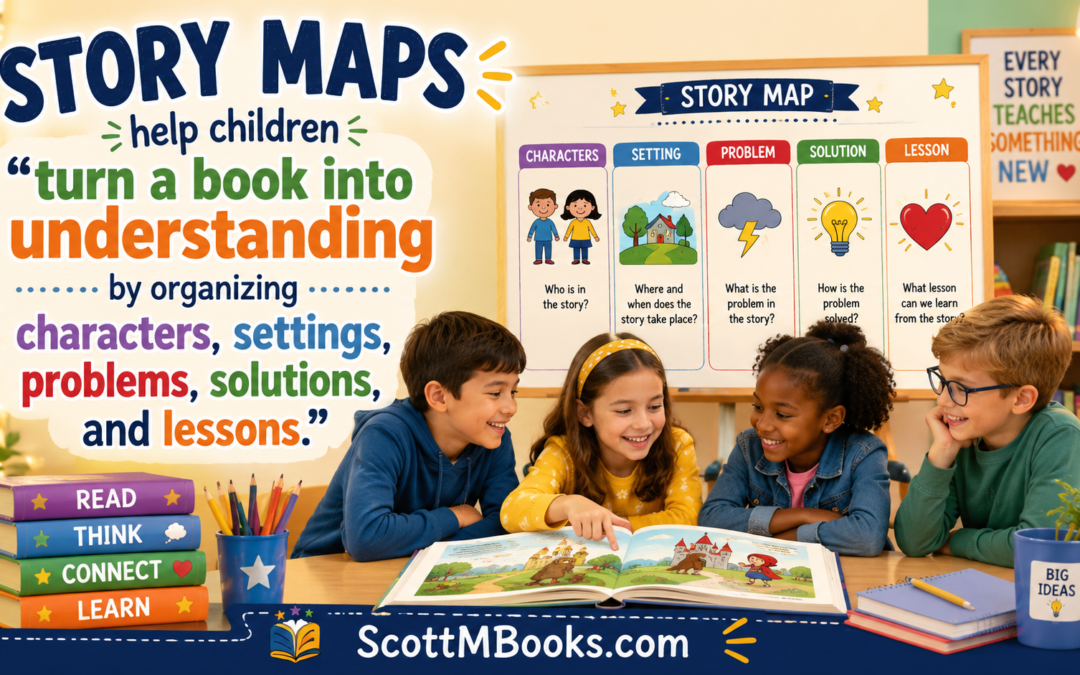
A story map is a graphic organizer that helps students identify the main parts of a story. Most story maps include:
Book title
Main character
Setting
Problem
Important events
Solution
Lesson or message
Some story maps are very simple, with only a few boxes. Others include more detailed questions for older students. The goal is the same: help students understand how the story works.
When children complete a story map, they learn to slow down and think about what they read.
Story Maps Help Students Find the Main Character
One of the first things students learn from a story map is how to identify the main character. The main character is usually the person or animal the story is mostly about.
This helps students ask:
Who is the story about?
What does this character want?
What problem does the character face?
How does the character change?
Understanding the main character helps children connect emotionally to the story. They begin to notice feelings, choices, and growth.
Story Maps Help Students Understand the Setting
The setting tells where and when the story happens. This may seem simple, but setting can shape the entire story.
A story might take place at school, at home, on a farm, at the beach, in the woods, at camp, or in a neighborhood. When students identify the setting, they better understand what is happening and why.
For example, a story at a wildlife center may teach responsibility and safe helping. A story at school may teach friendship or courage. A story at the beach may teach curiosity, patience, or family connection.
Setting gives the story a place to live.
Story Maps Help Students Identify the Problem
Most stories have a problem or challenge. The problem is what the character must face, solve, learn, or understand.
Students sometimes remember events but miss the main problem. A story map helps them focus on the central challenge.
The problem might be:
A character feels nervous
A friend needs help
An animal is in trouble
Someone makes a mistake
A character must try something new
A child needs to make a good choice
When students identify the problem, they begin to understand the story’s purpose.
Story Maps Help Students Follow the Events
Many children struggle to retell a story in order. They may remember one exciting scene but forget what happened before or after it.
Story maps help students organize events in sequence:
First
Next
Then
Finally
This helps children understand how one event leads to another. It also improves memory, retelling, writing, and discussion skills.
For younger students, drawing pictures in order can be very helpful. Older students can write sentences or short summaries.
Story Maps Help Students Understand the Solution
The solution explains how the problem is solved or how the story ends. This is an important part of reading comprehension because students learn to connect the beginning of the story to the ending.
A good story map helps students ask:
Was the problem solved?
Who helped solve it?
What choice made a difference?
What did the character learn?
This helps children see that stories are built around choices, actions, and growth.
Story Maps Help Students Find the Lesson
Many children’s books teach a lesson. The lesson might be about kindness, courage, responsibility, friendship, patience, honesty, empathy, or making good choices.
A story map can include a section called:
What did the story teach me?
What lesson did the character learn?
How can I use this lesson in real life?
This is especially useful for homeschool families and teachers who want reading time to support character development.
Stories become more meaningful when children connect them to their own lives.
Why Story Maps Work Well for Homeschooling
Story maps are easy to use at home because they do not require complicated planning. A homeschool parent can read a story with a child, then use a simple story map as a follow-up activity.
A story map can be used after:
A short picture book
A chapter from an eBook
A read-aloud session
Independent reading
A weekly reading lesson
Parents can ask questions aloud and write answers together, or older students can complete the page independently.
Story maps make reading time more structured without making it stressful.
Why Teachers Like Story Maps
Teachers often use story maps because they support many reading skills at once. A single story map can help students practice comprehension, sequencing, vocabulary, summarizing, writing, and critical thinking.
Story maps are also helpful for classroom discussion. Students can compare answers, explain their thinking, and talk about different parts of the story.
They work well for:
Whole-class read-alouds
Small reading groups
Reading centers
Independent reading responses
Book reports
Writing preparation
Story maps give students a clear path from reading to understanding.
Story Maps Support Writing Skills
Story maps do not only help with reading. They also help students become better writers.
When children understand how stories are built, they can begin to write their own stories. They learn that a story needs characters, a setting, a problem, events, and a solution.
A completed story map can become the outline for:
A summary
A book report
A creative writing piece
A new ending
A character reflection
A personal response
This makes story maps a useful bridge between reading and writing.
How to Use a Story Map with Any Book
Using a story map can be simple. After reading, ask students to complete these sections:
Title: What is the name of the book?
Main Character: Who is the story mostly about?
Setting: Where and when does the story happen?
Problem: What challenge or problem happens?
Events: What important things happen in order?
Solution: How is the problem solved?
Lesson: What did the story teach?
For younger students, allow drawing and short answers. For older students, encourage complete sentences and more detail.
Final Thoughts
Story maps help students become stronger readers by teaching them how to organize what they read. Instead of remembering random details, students learn to identify the most important parts of a story.
They begin to understand characters, settings, problems, events, solutions, and lessons. They also learn to retell stories, explain their thinking, and connect reading to real life.
For homeschool parents and teachers, story maps are among the easiest and most effective reading tools. They make reading more meaningful, organized, and engaging.
A simple story map can help a child move from reading the words to truly understanding the story.