Using Vocabulary Pages to Build Stronger Readers
Strong readers do more than recognize words. They understand what words mean, how words are used, and how vocabulary helps a story make sense. When children build vocabulary, they become better readers, stronger writers, and more confident learners.
One simple way parents and teachers can support vocabulary growth is by using vocabulary pages after reading. A vocabulary page gives students a place to choose new words, define them, use them in sentences, and connect them to the story.
For homeschool families, classroom teachers, and young readers, vocabulary pages are an easy and meaningful way to turn any children’s book into a stronger reading lesson.
Why Vocabulary Matters
Vocabulary is one of the building blocks of reading comprehension. When students know more words, they can understand more of what they read. If a child has to stop too often because words are unfamiliar, the story can become confusing or frustrating.
A strong vocabulary helps students:
Understand the story more clearly
Follow character actions and emotions
Recognize important details
Make better predictions
Explain their thoughts in writing
Speak with more confidence
Enjoy reading more
Vocabulary is not just about memorizing definitions. It is about helping children make meaning.
Vocabulary Pages Help Students Slow Down
Many children read quickly and skip over words they do not know. They may understand the basic idea of a story, but miss important details because they do not stop to think about unfamiliar words.
A vocabulary page encourages students to pause and notice words.
Instead of ignoring a new word, students can ask:
What does this word mean?
How was it used in the story?
Can I figure it out from the sentence?
Have I heard this word before?
Can I use this word in my own sentence?
This habit helps children become more thoughtful and careful readers.
Choose Words from the Story
Vocabulary lessons are most meaningful when the words come directly from the book a child is reading. Instead of giving students a random list, choose words that appear in the story.
These might include:
Words that describe feelings
Words that describe actions
Words connected to the setting
Words that help explain the problem
Words that show character traits
Words that are repeated in the story
Words that connect to the lesson or theme
For example, in a story about kindness, useful vocabulary words might include compassion, helpful, thoughtful, gentle, or responsible. In a story about courage, words might include brave, nervous, confident, determined, or fearful.
When vocabulary connects to the story, children understand why the words matter.
Use Context Clues
A vocabulary page can teach students how to use context clues. Context clues are the words and sentences around an unfamiliar word that help explain its meaning.
For example, if a story says a character “trembled as she stepped forward,” students may infer that trembled means shaking or feeling afraid.
Teachers and parents can ask:
What words around this word give you a clue?
What was happening in the story?
How did the character feel?
What do you think this word means?
Does your guess make sense in the sentence?
Using context clues helps students become independent readers. They learn that they do not always need to stop immediately and ask for help. They can think, look closely, and make a smart guess.
Include Definitions in Student-Friendly Language
When students write vocabulary definitions, the words should be simple enough for them to understand. A dictionary definition can sometimes be too advanced or confusing.
A better approach is to ask children to explain the word in their own words.
For example:
Courage means being brave even when something feels hard.
Responsibility means doing your part and taking care of what you should.
Compassion means caring about someone’s feelings and wanting to help.
When students explain vocabulary in their own language, they are more likely to remember it.
Use the Word in a Sentence
Writing a sentence helps students practice using the word correctly. It also shows whether they truly understand the meaning.
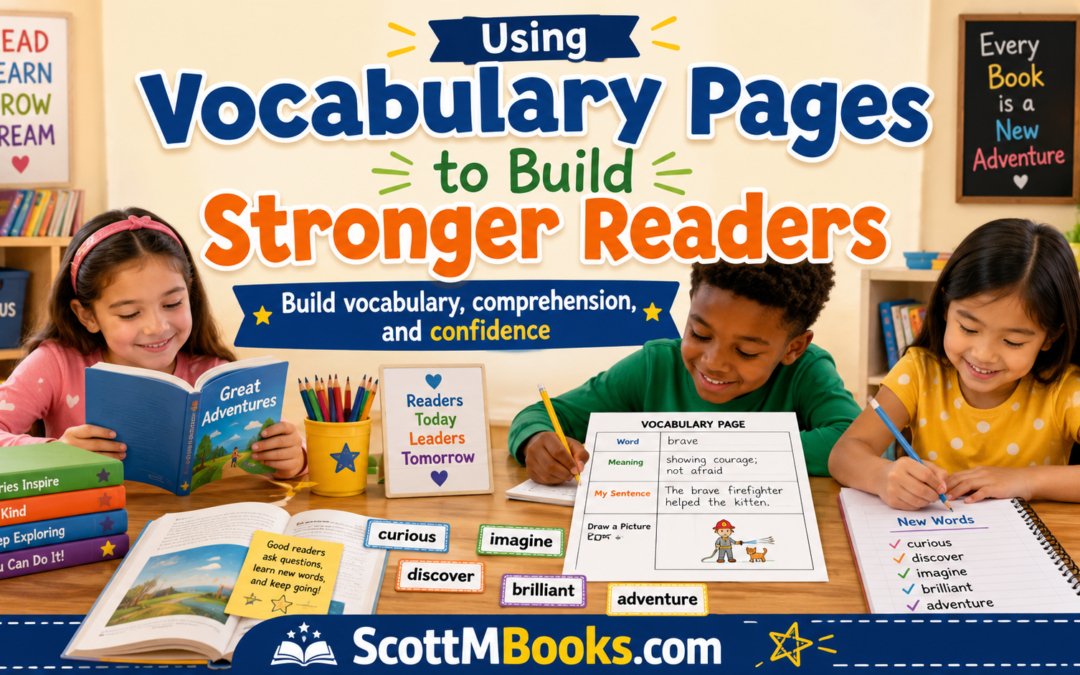
A vocabulary page might include:
Vocabulary Word:
What It Means:
Sentence from the Story:
My Own Sentence:
This structure helps children connect the word to the book and then apply it in a new way.
For younger students, the sentence can be simple. For older students, encourage more detailed sentences that show deeper understanding.
For example:
Simple sentence: Lily showed courage.
Lily showed courage by helping, even though she felt nervous.
Add Drawing for Younger Learners
Drawing can help children remember vocabulary words, especially in younger grades. When students draw a picture to represent a word, they are thinking about meaning visually.
A child might draw:
A character helping someone for kindness
A child crossing a bridge for courage
A pet being cared for for responsibility
Two friends sharing for friendship
A thoughtful face for reflection
Drawing makes vocabulary more engaging and helps visual learners connect words to ideas.
Build Vocabulary Through Character Traits
Children’s books often include strong character traits. Vocabulary pages can help students learn words that describe who characters are and how they act.
Useful character trait words include:
Kind
Brave
Helpful
Patient
Honest
Curious
Responsible
Thoughtful
Generous
Determined
Compassionate
Confident
After reading, students can choose one character and select vocabulary words that describe that character. Then they can explain what the character did to show that trait.
For example:
Character: Ben
Trait Word: Compassionate
Evidence: He cared about turtles and wanted to help them safely.
This activity builds vocabulary and comprehension at the same time.
Connect Vocabulary to Writing
Vocabulary pages can also strengthen writing. When students learn new words from books, they can use those words in their own responses, stories, and reflections.
After completing a vocabulary page, ask students to write a short paragraph using two or three of the words.
A prompt might be:
Write about a character who showed courage and kindness. Use at least two vocabulary words from your page.
This helps students move vocabulary from recognition to use. The more children practice using new words, the more naturally those words become part of their reading and writing.
Make Vocabulary Part of Discussion
Vocabulary should not only be a written activity. Talking about words helps children hear and use language in meaningful ways.
During or after reading, ask:
Which word was new to you?
Which word helped you understand the character?
Which word describes the lesson of the story?
Which word would you use to describe the main character?
Which word do you want to use in your own writing?
These conversations help children become more comfortable with language. They also make vocabulary feel useful instead of separate from reading.
Use Vocabulary Pages with Any Book
One of the best things about vocabulary pages is that they can be used with almost any children’s book. Parents and teachers do not need a separate worksheet for every story. A simple vocabulary template can work again and again.
A basic vocabulary page can include:
Book title
Vocabulary word
Meaning
Sentence from the story
My own sentence
Picture or example
Favorite new word
Word I want to use again
This makes vocabulary practice easy to repeat as part of a regular reading routine.
Vocabulary Pages for Homeschool Families
Vocabulary pages work especially well in homeschooling because they are flexible. Parents can use them with read-alouds, independent reading, chapter books, eBooks, or weekly reading units.
A simple homeschool plan might look like this:
Read a story or chapter
Choose three vocabulary words
Talk about what each word means
Write student-friendly definitions
Use each word in a sentence
Draw or discuss one word
Review the words later in the week
This short routine can help children build stronger word knowledge over time.
Vocabulary Pages for Teachers
Teachers can use vocabulary pages in many classroom settings. They work well for whole-class read-alouds, small reading groups, literacy centers, independent reading, and homework practice.
Teachers can also use vocabulary pages to support:
Reading comprehension
Writing development
Character education
Social-emotional learning
Book discussions
Word walls
Reading journals
A classroom word wall can be created from vocabulary words students find in books. Over time, students build a shared collection of meaningful words.
Keep Vocabulary Practice Encouraging
Vocabulary should help children feel more confident, not discouraged. Students do not need to master every word immediately. The goal is steady growth.
Celebrate when a child notices a new word, makes a smart guess, uses context clues, or tries to include a new word in writing.
Encouragement matters. A child who feels successful with words is more likely to keep reading, asking questions, and learning.
Final Thoughts
Vocabulary pages are simple, but they can make a big difference. They help students slow down, notice important words, understand stories more deeply, and use stronger language in speaking and writing.
When vocabulary comes from meaningful children’s books, students see words in action. They learn how words describe feelings, choices, settings, problems, solutions, and lessons.
For homeschool parents and teachers, vocabulary pages are an easy way to build stronger readers one word at a time.
A child who understands more words can understand more stories. And a child who understands more stories has more ways to think, imagine, learn, and grow.