Questions to Ask After Reading a Story Together
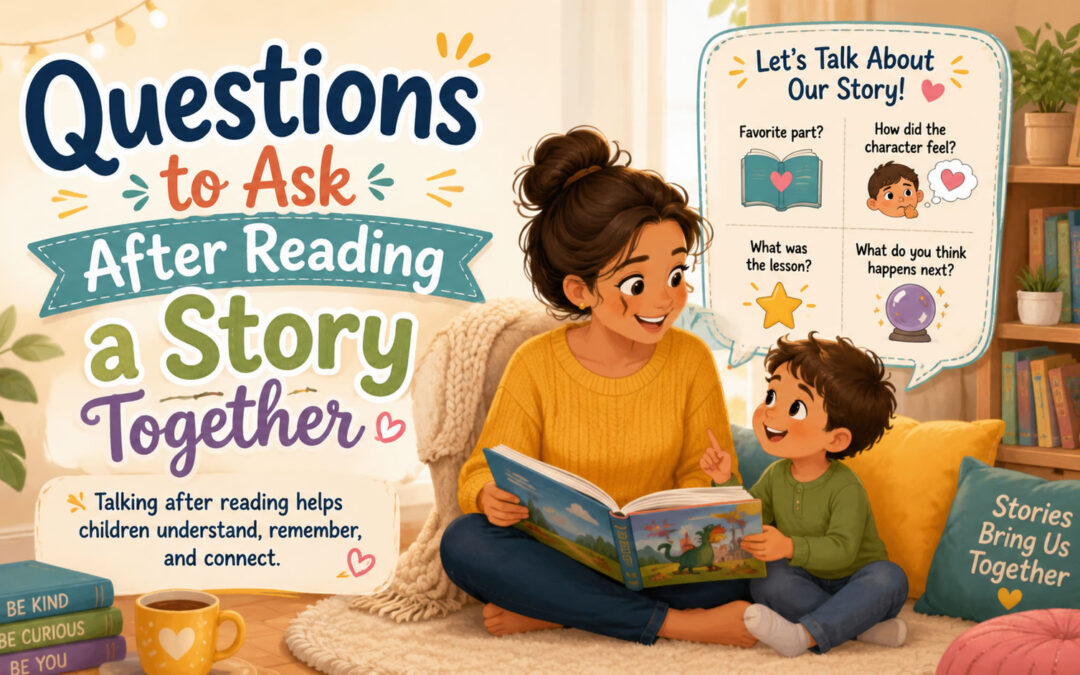
Reading a story with a child is about more than finishing the final page. The conversation that follows can help children understand the story, remember important details, build vocabulary, express feelings, and connect the book’s lesson to everyday life.
Parents, teachers, and homeschool educators do not need to turn every story into a formal lesson. A few thoughtful questions can create a meaningful discussion while still keeping reading enjoyable.
The best questions are open-ended. Instead of asking only questions with one correct answer, invite children to explain what they noticed, thought, felt, and learned.
Start with Simple Recall Questions
Recall questions help children remember the basic events of the story. These are especially useful for younger readers or children who are still developing reading-comprehension skills.
Try asking:
- Who were the main characters?
- Where did the story take place?
- What happened at the beginning?
- What problem did the character face?
- What happened in the middle of the story?
- How was the problem solved?
- What happened at the end?
These questions help children organize the story in their minds. They also provide a foundation for deeper discussion.
Avoid asking too many questions at once. Choose two or three that fit the child’s age and the length of the story.
Ask About a Favorite Part
One of the easiest ways to begin a relaxed conversation is to ask what the child enjoyed.
You might ask:
- What was your favorite part of the story?
- Which picture did you like best?
- Which character was the most interesting?
- Was there a part that made you laugh?
- Was there a part that surprised you?
- Which part would you like to read again?
Children are often more willing to talk when they can begin with their personal reactions. Their answers can also reveal what captured their attention and what they understood most clearly.
Talk About the Characters
Stories give children a safe way to explore behavior, decisions, relationships, and emotions. Questions about characters can help children think beyond what happened and begin considering why it happened.
Ask questions such as:
- How would you describe the main character?
- What did the character want?
- What was the character worried about?
- What choice did the character make?
- Was that a good choice? Why or why not?
- What did the character learn?
- How did the character change by the end?
- Which character would you want as a friend?
- Did one character help another?
Encourage children to support their answers with details from the story. A child might say, “I think she was brave because she helped even though she was afraid.”
This type of response builds both comprehension and critical-thinking skills.
Explore Feelings
Many children’s stories involve feelings such as fear, excitement, disappointment, jealousy, courage, loneliness, kindness, and pride.
Questions about emotions help children learn how to recognize and name feelings.
Consider asking:
- How did the character feel at the beginning?
- What made the character feel that way?
- Did the character’s feelings change?
- How do you think the other characters felt?
- Which part of the story felt happy or sad?
- Have you ever felt the same way?
- What helped the character feel better?
- What could a friend have said or done to help?
Children may interpret a character’s feelings differently. Allow them to explain their ideas instead of insisting on one answer.
Discuss the Problem and Solution
Most stories include a challenge, conflict, mistake, or problem. Talking about how the characters handled it can help children strengthen problem-solving skills.
Ask:
- What was the main problem?
- Why did the problem happen?
- What did the character try first?
- Did that plan work?
- Who helped solve the problem?
- Was the solution fair?
- Could the problem have been solved another way?
- What would you have done?
These questions encourage children to think about cause and effect. They also help them practice considering more than one possible solution.
Ask Prediction Questions
Prediction questions keep children actively involved in a story. They can be asked during reading or after the book is finished.
During the story, ask:
- What do you think will happen next?
- Why do you think that?
- Do you think the character will solve the problem?
- What clues helped you make that prediction?
After reading, ask:
- Was your prediction correct?
- What surprised you?
- What might happen after the story ends?
- What do you think the character will do tomorrow?
- What could happen in a sequel?
Predictions do not have to be correct to be valuable. The goal is to help children use clues, imagination, and reasoning.
Identify the Story’s Lesson
Many children’s books teach lessons about kindness, responsibility, patience, courage, friendship, honesty, or making good choices.
Instead of telling children the lesson immediately, invite them to discover it.
You might ask:
- What do you think this story teaches?
- What did the main character learn?
- What mistake did the character make?
- What should the character remember next time?
- Did the story teach anything about friendship?
- Did the story teach anything about kindness?
- How could we use this lesson in real life?
Children may identify more than one lesson. One child may focus on courage while another notices teamwork. Both answers may be reasonable.
Connect the Story to Real Life
Stories become more meaningful when children can relate them to their own experiences.
Try asking:
- Has anything like this ever happened to you?
- Have you ever felt the way the character felt?
- What would you do in the same situation?
- Does this character remind you of anyone?
- Have you ever helped someone like this character did?
- Where could we use this lesson at home or school?
- What is one thing you could try this week?
These questions help children understand that books can offer guidance for real situations.
Be careful not to pressure children to share something personal. Let them choose how much they want to say.
Encourage Creative Thinking
Not every question needs to focus on comprehension. Imaginative questions can make reading discussions fun and memorable.
Ask:
- What would you change about the story?
- Can you create a different ending?
- What new character would you add?
- What would happen if the story took place somewhere else?
- What would you ask the main character?
- What title would you give the story?
- Which scene would you like to draw?
- What would happen in the next chapter?
Creative questions are especially useful for children who enjoy art, storytelling, acting, or imaginative play.
Discuss New Words
Books introduce children to words they may not hear in ordinary conversation. After reading, choose one or two interesting words from the story.
Ask:
- Did you hear a new word?
- What do you think that word means?
- What clues helped you understand it?
- Can you use the word in a sentence?
- What is another word that means something similar?
- Can you draw a picture showing the word?
Keep vocabulary discussions brief. The goal is to build curiosity about language, not interrupt the enjoyment of the story.
Questions for Younger Children
Preschool and early elementary children often respond best to simple, concrete questions.
Try:
- Who was in the story?
- What happened first?
- What color was the character’s hat?
- How did the character feel?
- What was your favorite picture?
- Was the character kind?
- What happened at the end?
- Can you show me your favorite page?
Young children may answer with one word, point to a picture, or act out part of the story. These are all meaningful forms of participation.
Questions for Older Children
Older elementary students can usually handle questions that require explanation, comparison, and evidence.
Try:
- Why do you think the character made that decision?
- What caused the main problem?
- Which character changed the most?
- Was the ending believable?
- What evidence supports your answer?
- What was the author trying to teach?
- How would the story change from another character’s point of view?
- Which part of the story was most important?
- Would you recommend this book? Why?
These questions help children move from basic recall to deeper analysis.
Keep the Conversation Natural
A reading discussion should not feel like a test. Children may become frustrated if they are asked too many questions or corrected after every answer.
Keep the conversation positive by:
- Asking only a few questions
- Giving the child time to think
- Accepting different interpretations
- Sharing your own thoughts
- Avoiding constant correction
- Following the child’s interests
- Ending while the discussion is still enjoyable
You might say, “I thought the character was nervous, but you noticed that she was also excited. What made you think that?”
This shows children that reading can lead to different ideas and thoughtful conversations.
Let the Child Ask Questions
Children should also have opportunities to ask their own questions.
Encourage them by saying:
- Is there anything you are wondering about?
- Was any part confusing?
- What would you like to ask the author?
- What would you like to ask the character?
- Is there something you want to learn more about?
A child’s questions can reveal curiosity, confusion, and personal interests. They may also lead to new books, activities, or learning projects.
Add a Simple Follow-Up Activity
After the discussion, children can respond to the story with a brief activity.
They might:
- Draw their favorite scene
- Write a sentence about the lesson
- Create a new ending
- Make a character-feelings chart
- Act out an important scene
- Write a letter to a character
- Complete a book review
- Draw the beginning, middle, and end
- Perform an act of kindness inspired by the story
Not every book needs an activity. Sometimes a warm conversation is the best response.
A Simple Five-Question Routine
Parents and educators can use the following five questions with almost any children’s book:
- What was your favorite part?
- What problem happened in the story?
- How did the character feel?
- What did the character learn?
- What would you have done?
This simple routine covers enjoyment, comprehension, feelings, lessons, and personal connections without overwhelming the child.
Final Thoughts
The questions asked after a story can be just as valuable as the reading itself. Thoughtful conversations help children remember what they read, understand characters, recognize feelings, solve problems, and connect important lessons to their own lives.
The goal is not to ask every possible question. Choose a few that fit the story, the child’s age, and the moment.
When reading discussions remain relaxed, respectful, and enjoyable, children learn that books are not simply assignments. They are opportunities to wonder, imagine, reflect, and talk about the world together.