How Read-Aloud Time Builds Stronger Readers
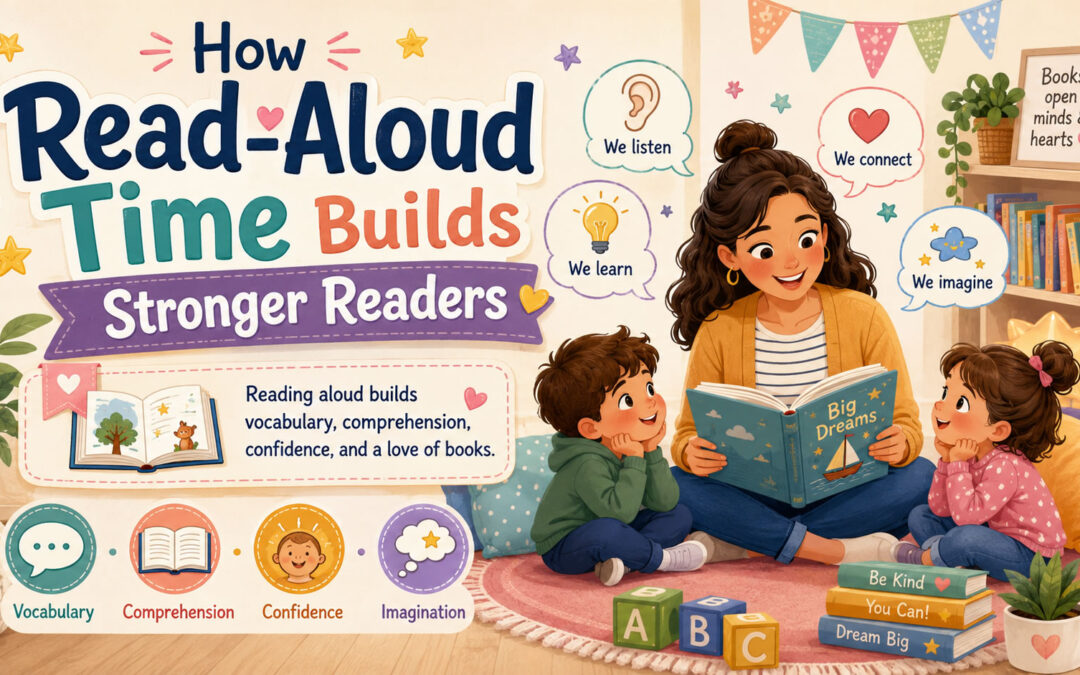
Reading aloud to children is one of the simplest and most powerful ways to support literacy development. Whether it happens in a classroom, during a homeschool lesson, or before bedtime, read-aloud time helps children develop the language, comprehension, confidence, and curiosity they need to become stronger readers.
Children do not need to read every word independently to benefit from a book. When they listen to an adult read, study the illustrations, predict what may happen next, and discuss the characters, they are practicing important reading skills.
A consistent read-aloud routine also helps children see books as sources of enjoyment, comfort, discovery, and connection.
Read-Aloud Time Expands Vocabulary
Books often contain words children may not hear during everyday conversations. A story might introduce words such as enormous, curious, grateful, determined, or disappointed.
Children may not understand every new word immediately, but hearing words within a meaningful story helps them begin to understand what those words mean.
For example, a child may better understand the word nervous after listening to a story about a character starting at a new school. The character’s actions, facial expressions, and experiences provide clues that make the word easier to understand.
Adults can support vocabulary growth by briefly discussing one or two interesting words.
Try asking:
- What do you think this word means?
- What clue did the story give us?
- Can you use the word in a sentence?
- What is another word that means something similar?
Vocabulary discussions should remain brief so that children can continue enjoying the story.
Children Hear Fluent Reading
When adults read aloud, they demonstrate what fluent reading sounds like.
Children hear:
- Clear pronunciation
- Natural pacing
- Expression
- Pauses at punctuation
- Changes in tone
- Emphasis on important words
- Different voices for characters
This teaches children that reading is not simply recognizing and saying words. Reading is also about understanding and communicating meaning.
Adults do not need to become professional performers. A warm voice, clear pacing, and natural expression are enough to help children hear how good reading sounds.
Read-Alouds Strengthen Comprehension
Children can often understand stories that are more advanced than the books they can read independently. When an adult handles the reading, children can concentrate on understanding the characters, events, problems, and lessons.
While listening, children practice:
- Remembering important details
- Following the order of events
- Identifying the setting
- Recognizing a problem and solution
- Understanding cause and effect
- Making predictions
- Comparing characters
- Identifying the story’s main lesson
These are the same skills children will eventually need when reading independently.
After reading, adults can ask a few simple questions:
- Who were the main characters?
- What problem happened?
- How was the problem solved?
- What was your favorite part?
- What did the character learn?
A relaxed conversation is usually more helpful than a long list of test-like questions.
Listening Builds Attention and Memory
Following a story requires children to pay attention and remember what happened earlier. As the story continues, they must connect previous events with new information.
Young children may initially listen for only a few minutes. With regular read-aloud practice, their ability to concentrate often improves.
Adults can help children stay engaged by:
- Choosing books that match their interests
- Reading in a quiet, comfortable place
- Keeping early sessions short
- Allowing children to study the illustrations
- Pausing occasionally for a prediction
- Reading at a consistent time each day
- Stopping before the child becomes overly tired
The goal is to strengthen attention gradually, not to force children to sit still for long periods.
Read-Aloud Time Teaches Story Structure
By hearing many stories, children begin to understand how stories are organized.
They learn that most stories include:
- Characters
- A setting
- A beginning
- A problem or goal
- Important events
- A solution
- An ending
This understanding helps children predict what may happen and remember what they have heard.
It also supports their writing. Children who understand how stories work are better prepared to create their own characters, problems, events, and endings.
After reading, ask children to retell the story using three simple parts:
- What happened at the beginning?
- What happened in the middle?
- What happened at the end?
Younger children can draw the three parts instead of writing them.
Read-Alouds Encourage Prediction and Critical Thinking
Prediction questions encourage children to think actively about a story.
Before reading, look at the cover and ask:
- What do you think this story will be about?
- What clues do you see in the picture?
- Where do you think the story takes place?
- How do you think the character feels?
During the story, ask:
- What do you think will happen next?
- Do you think the character’s plan will work?
- How might the problem be solved?
- What makes you think that?
Predictions do not need to be correct. The purpose is to help children use story clues, background knowledge, and reasoning.
After the story, children can compare their predictions with what actually happened.
Books Build Background Knowledge
Read-aloud time introduces children to people, places, ideas, and experiences beyond their immediate surroundings.
Stories and informational books can teach children about:
- Animals
- Nature
- Community helpers
- Different cultures
- Historical events
- Family traditions
- Science
- Art
- Friendship
- School experiences
A story about a farm may introduce children to crops, animals, chores, and seasonal changes. A wildlife rescue story may teach them about habitats, injured animals, and the importance of asking an adult for help.
The more children learn about the world, the easier it becomes for them to understand future books and lessons.
Read-Alouds Help Children Understand Feelings
Children’s stories often explore emotions such as excitement, fear, disappointment, loneliness, jealousy, pride, and courage.
Talking about a character’s emotions helps children learn how to recognize and describe feelings.
Ask questions such as:
- How did the character feel?
- What made the character feel that way?
- Did the character’s feelings change?
- What helped the character feel better?
- Have you ever felt something similar?
- What could a friend have done to help?
Stories give children a safe way to discuss difficult feelings. Some children may find it easier to talk about a fictional character before discussing their own experiences.
Stories Teach Values and Life Lessons
Children’s books can introduce important values without making the discussion feel like a lecture.
Stories can teach children about:
- Kindness
- Responsibility
- Courage
- Patience
- Honesty
- Friendship
- Inclusion
- Empathy
- Cooperation
- Making thoughtful choices
Characters allow children to observe decisions and consequences.
After reading, adults might ask:
- What choice did the character make?
- Was it a helpful choice?
- Who showed kindness?
- What did the character learn?
- What could the character do differently next time?
- How could we use this lesson in our lives?
Children may identify different lessons from the same story. Encourage them to explain their ideas.
Read-Aloud Time Supports Beginning Readers
Beginning readers often work hard to identify letters, sounds, and words. Because decoding requires so much attention, they may struggle to focus on the larger meaning of a story.
Reading aloud allows them to enjoy books without the pressure of reading every word independently.
Adults can invite beginning readers to participate by asking them to:
- Read a familiar word
- Finish a repeated sentence
- Identify a rhyming word
- Point to the title
- Find a word beginning with a certain letter
- Retell what happened on the previous page
- Read one short section aloud
These moments should feel supportive rather than demanding. Read-aloud time should not become a hidden test.
Older Children Still Benefit from Read-Alouds
Many adults stop reading aloud once children can read independently. However, older children can continue to benefit from hearing books read aloud.
Read-alouds give older children access to:
- Longer chapter books
- Historical fiction
- Poetry
- Biographies
- Informational books
- Complex vocabulary
- Deeper themes
- Stories above their independent reading level
Shared reading also creates opportunities to discuss character motivations, different points of view, difficult decisions, and important themes.
A family or class chapter book can become something children look forward to each day.
Reading Aloud Builds Confidence
Children who struggle with reading may begin to believe that books are too difficult or that they are not capable readers.
Read-aloud time allows them to participate successfully.
They can:
- Listen
- Make predictions
- Study illustrations
- Discuss characters
- Ask questions
- Share opinions
- Connect the story to their lives
These are all meaningful reading behaviors.
Adults can encourage confidence by saying:
- You noticed an important detail.
- That was a thoughtful prediction.
- I like how you explained your answer.
- You remembered what happened earlier.
- That is an interesting way to understand the character.
Praise effort, thinking, and participation rather than focusing only on correct answers.
Reading Together Strengthens Relationships
Read-aloud time is not only an academic activity. It also creates a meaningful connection between adults and children.
A shared story provides time to slow down, sit together, laugh, wonder, and talk.
Children may remember:
- A favorite bedtime story
- A funny character
- Waiting for the next chapter
- Sitting beside a parent or teacher
- Discussing a character’s difficult choice
- Discovering a book they wanted to hear again
These positive experiences help children associate reading with comfort, attention, and belonging.
How Long Should Read-Aloud Time Last?
Read-aloud sessions do not need to be long.
A general starting point is:
- Five to ten minutes for toddlers and preschoolers
- Ten to fifteen minutes for kindergarten children
- Fifteen to twenty minutes for early elementary students
- Twenty to thirty minutes for older elementary students
These times are only guidelines. Some children enjoy longer sessions, while others need shorter ones.
A positive ten-minute reading routine each day is more valuable than an occasional long session that leaves everyone frustrated.
Choosing a Good Read-Aloud Book
A good read-aloud book should be interesting, understandable, and appropriate for the child’s age.
Look for books with:
- Engaging characters
- Clear illustrations
- An interesting problem
- Rich but understandable language
- Opportunities for prediction
- Meaningful lessons
- Humor, emotion, or adventure
- A satisfying ending
Whenever possible, allow children to help choose the book. Children are often more attentive when they have some control over what is read.
It is also helpful to provide variety. Read picture books, chapter books, poetry, nonfiction, biographies, and stories from different cultures and perspectives.
A Simple Read-Aloud Routine
Parents, teachers, and homeschool educators can use the following routine with almost any book.
Before Reading
Look at the cover and title. Ask the child to make one prediction.
During Reading
Read with natural expression. Pause once or twice to discuss an important event, new word, or character feeling.
After Reading
Ask two or three questions, such as:
- What was your favorite part?
- What problem happened?
- How did the character feel?
- What did the character learn?
- What would you have done?
Optional Follow-Up Activity
Children might:
- Draw their favorite scene
- Retell the beginning, middle, and end
- Write about the main character
- Create a different ending
- Complete a book review
- Act out an important scene
- Perform an act of kindness inspired by the story
Not every reading session needs a written activity. Some days, enjoying the story and talking together is enough.
Keep Read-Aloud Time Positive
Read-aloud time is most effective when children see it as an enjoyable part of the day.
Try to avoid:
- Interrupting after every page
- Asking too many questions
- Correcting every response
- Choosing books that are consistently too difficult
- Requiring a worksheet after every story
- Using reading as punishment
- Comparing children’s answers or abilities
Instead, encourage curiosity, imagination, conversation, and enjoyment.
Children may ask to hear the same story many times. Repeated reading is valuable. Familiar books help children remember vocabulary, notice new details, join in with repeated lines, and build confidence.
Final Thoughts
Reading aloud is one of the most effective ways parents, teachers, and homeschool educators can help children become stronger readers.
It builds vocabulary, comprehension, attention, background knowledge, emotional understanding, and confidence. It also gives children the opportunity to experience books as enjoyable and meaningful.
A successful read-aloud routine does not require expensive materials or complicated lesson plans. It begins with a good book, a comfortable place, a few thoughtful questions, and an adult willing to share the experience.
When children regularly hear stories read with warmth and enthusiasm, they are not only learning how reading sounds. They are discovering why reading matters.