How Story Sequencing Activities Improve Comprehension
Understanding a story involves more than remembering the characters or identifying what happened at the end. Children also need to recognize the order in which events occur and understand how one event leads to another. Story sequencing activities help young readers organize information, follow a plot, notice cause-and-effect relationships, and retell a story clearly. These skills form an important foundation for stronger reading comprehension.
What Is Story Sequencing?
Story sequencing means placing the events of a story in the correct order. Children learn to identify what happened first, what happened next, and how the story ended.
For example, after reading a story, a child might explain:
- Sally notices someone sitting alone.
- Sally invites the child to play.
- The children begin talking and playing together.
- The child feels welcomed and included.
When children arrange events in order, they are showing that they understand how the story developed. They are not simply recalling separate details; they are connecting those details into a meaningful sequence.
Sequencing Helps Children Understand the Plot
Every story has a beginning, middle, and end. The beginning usually introduces the characters, setting, and main situation. The middle shows the problem, important events, and the characters’ attempts to respond. The ending explains how the problem is resolved and what the characters learn.
Children who struggle with sequencing may remember individual scenes but have difficulty explaining how those scenes fit together. A sequencing activity gives them a structure for organizing their thoughts.
Questions such as these can help:
- What happened at the beginning?
- What problem did the character face?
- What did the character do next?
- How was the problem solved?
- What happened at the end?
These questions guide children toward the most important parts of the story rather than asking them to remember every small detail.
Sequencing Strengthens Memory
Arranging story events in order helps children remember what they have read. Instead of storing the story as a collection of unrelated facts, children begin to see it as a connected chain of events.
Words such as first, next, then, after that, and finally provide helpful memory cues. A child may not immediately remember every part of a chapter, but the prompt “What happened after Lily found the injured animal?” can help the child recall the next event.
Sequencing activities are especially useful after read-aloud time because they encourage children to review the story while it is still fresh in their minds.
Children Learn Cause and Effect
Story events usually happen for a reason. A character makes a decision, and that decision produces a result. Sequencing helps children recognize these cause-and-effect relationships.
For example:
- Thomas practices riding his bicycle, so he becomes more confident.
- Sally invites someone to join a game, so the child no longer feels left out.
- Lily asks an adult for help, so an animal can be cared for safely.
- Ben completes a kind act, so another person feels supported.
When children understand why an event happened, their comprehension becomes deeper. They begin to think about character motivation, consequences, problem-solving, and the lessons within the story.
Sequencing Improves Retelling Skills
Retelling a story is an excellent way to check comprehension. A child who understands the story should be able to explain the main events in a logical order.
Sequencing activities help children avoid jumping randomly from one scene to another. They provide a simple framework for retelling:
- Who was in the story?
- Where did the story take place?
- What happened first?
- What was the main problem?
- What important actions followed?
- How did the story end?
Retelling also supports speaking and writing skills. Children practice forming complete sentences, choosing important details, and explaining ideas clearly.
Sequencing Supports Writing Development
The ability to organize events is not limited to reading. Children also need sequencing skills when writing personal narratives, summaries, book reports, and original stories.
A child who understands story order is better prepared to write a clear paragraph or story. Instead of listing disconnected ideas, the child can organize events so that the reader can follow what happened.
After completing a sequencing page, children can use their answers to write a short summary. Younger students might write one sentence for the beginning, one for the middle, and one for the ending. Older students can add details about the problem, character choices, and lesson.
Simple Story Sequencing Activities
Story sequencing does not have to be complicated. Teachers and homeschool parents can use several easy approaches.
Event Cards
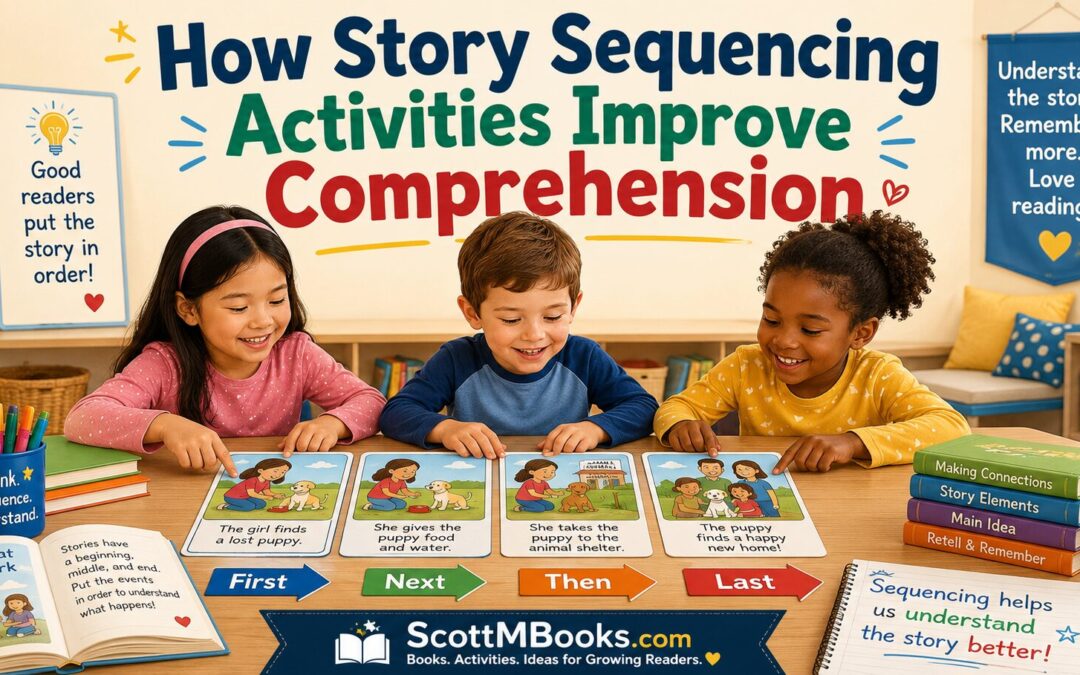
Write or print four to six important story events on separate cards. Ask the child to place the cards in the correct order. The child can then use the cards to retell the story.
Picture Sequencing
Younger children can arrange pictures showing important scenes. This allows children to practice comprehension even when they are still developing their writing skills.
Beginning, Middle, and End
Divide a page into three sections. Children draw or write what happened during each part of the story. This activity helps them recognize the basic structure of a narrative.
Number the Events
Provide several events in mixed order and ask the child to number them. Afterward, discuss why each event belongs in that position.
Sequence and Explain
Ask children to place the events in order and explain how they know. This adds critical thinking to the activity because children must support their answers with information from the book.
Adjusting Sequencing Activities for Different Ages
For younger readers, begin with three major events and use pictures whenever possible. Children can describe the events aloud while an adult writes their responses.
As children gain confidence, increase the number of events and ask them to include more details. Older readers can sequence events across several chapters, identify turning points, or explain how an earlier event affected the ending.
The goal is not to make children memorize every detail. The goal is to help them recognize the events that are most important to the story’s meaning.
Using ScottMBooks Activity Pages
The printable Activity Pages available with books from ScottMBooks.com can help children review story events in an organized and enjoyable way. Sequencing exercises can be combined with comprehension questions, vocabulary practice, character reflection, writing prompts, and drawing activities.
After reading a story about Lily, Sally, Thomas, or Ben, children can place the main events in order and then discuss how the characters’ choices influenced what happened next. This helps turn reading time into a broader lesson about kindness, courage, responsibility, friendship, empathy, and making good choices.
Building Stronger Readers One Event at a Time
Story sequencing is a simple activity with many educational benefits. It strengthens memory, improves comprehension, develops retelling skills, reinforces cause and effect, and prepares children to become more organized writers.
By regularly asking children to identify what happened first, next, and last, adults help them look beyond individual details and understand the story as a complete experience. With practice, children become more confident readers who can follow a plot, explain character decisions, recognize important lessons, and communicate what they have learned.