
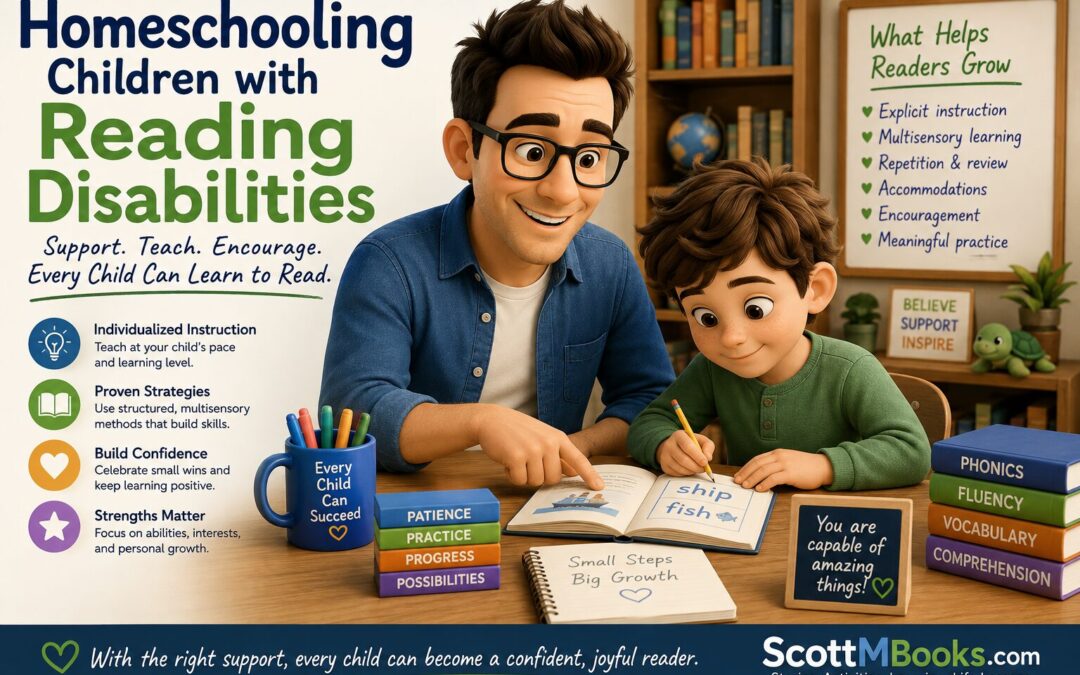
Homeschooling Children With Reading Disabilities
Homeschooling can give children with reading disabilities something especially valuable: time, flexibility, individualized instruction, and the freedom to learn without constant comparison. A child who struggles to read may need more repetition, clearer instruction, shorter lessons, specialized materials, or alternative ways to demonstrate understanding. At home, parents can adjust the pace while protecting the child’s confidence and continuing to nurture curiosity.
Reading disabilities can affect word recognition, decoding, spelling, fluency, and comprehension. Dyslexia, for example, is a specific learning disability involving persistent difficulty with accurate or fluent word reading and spelling. These challenges do not mean that a child lacks intelligence, motivation, creativity, or the ability to learn.
The goal of homeschooling should not be to remove every difficult task. It should be to provide the right kind of instruction, appropriate support, and enough successful practice for the child to become a more capable and confident reader.
Recognizing Possible Reading Difficulties
Children develop reading skills at different rates, and an occasional struggle does not necessarily indicate a disability. However, persistent difficulties may deserve closer attention.
Possible signs include:
- Difficulty connecting letters with their sounds
- Trouble sounding out unfamiliar words
- Frequent guessing based on pictures or the first letter
- Slow, effortful reading
- Difficulty recognizing familiar words
- Ongoing spelling problems
- Trouble remembering rhyming words
- Avoidance of reading assignments
- Difficulty understanding what was read
- Becoming unusually tired or frustrated during reading
- Giving up when a passage looks long
- Strong listening comprehension but weak independent reading
The signs of a reading disorder differ from one child to another. Common concerns include difficulty spelling, sounding out words, reading accurately, reading fluently, and understanding written material.
Parents should avoid assuming that a child is lazy or careless. Reading may require far more effort for that child than it does for a sibling or peer.
Consider a Professional Evaluation
A homeschool parent can observe a child closely, but observation alone cannot identify the exact cause of a reading problem. Difficulties may involve phonological awareness, decoding, language processing, fluency, attention, working memory, hearing, vision, or another area.
A comprehensive evaluation can identify specific strengths and weaknesses and help determine where instruction should begin. Reading evaluations may examine word recognition, spelling, phonological processing, fluency, vocabulary, comprehension, memory, and other relevant skills.
Parents may seek help from:
- A licensed psychologist or neuropsychologist
- A school psychologist
- A speech-language pathologist
- A qualified dyslexia evaluator
- A reading specialist
- A pediatrician who can provide referrals
- The local public-school district
Families in the United States may also contact their local school district to ask about evaluation procedures. The Individuals with Disabilities Education Act requires public agencies to identify and evaluate eligible children with suspected disabilities, although the services available to independently homeschooled students vary by state, district, and the legal structure under which the child is homeschooled. Parents should verify current rules with their state education agency and local district rather than assume that all homeschool students receive the same services.
Use Explicit, Structured Reading Instruction
Many children learn to read with relatively informal instruction. A child with a reading disability may need each skill to be taught directly and in a carefully planned order.
Structured Literacy is an approach designed to teach the organization of written language explicitly, systematically, and cumulatively. Instruction begins with foundational concepts and progresses toward more complex skills, with each new lesson building on previously mastered material. This approach is especially important for students with dyslexia and related reading difficulties.
Effective instruction may include:
Phonological Awareness
Children learn to hear and work with the sounds in spoken words before connecting those sounds to print.
Activities may involve:
- Identifying rhyming words
- Counting syllables
- Blending separate sounds into a word
- Separating a word into individual sounds
- Removing or replacing a sound
- Comparing words that begin or end alike
For example, a parent might say the sounds /m/ /a/ /p/ and ask the child to blend them into “map.”
Sound-Symbol Relationships
Children need direct instruction in how letters and letter combinations represent sounds.
Instead of expecting the child to discover patterns independently, teach them clearly:
“The letters sh work together to represent one sound, as in ship.”
Then provide several opportunities to read, spell, say, and write words containing that pattern.
Decoding
Decoding is the process of using sound-symbol knowledge to read unfamiliar words. Children should practice reading words that contain the patterns they have already been taught.
Teach the child to move through the entire word rather than guessing from:
- The picture
- The first letter
- The shape of the word
- The surrounding sentence
Pictures and context are useful for understanding a story, but they should not replace accurate word reading.
Spelling and Encoding
Reading and spelling support one another. Ask the child to listen to a word, identify its sounds, choose the corresponding letters, and write the word.
A simple routine might be:
- Say the word.
- Use it in a sentence.
- Ask the child to repeat it.
- Stretch or segment the sounds.
- Write one letter or letter group for each sound.
- Read the completed word.
Syllables and Word Parts
As children progress, teach them how longer words are organized. They can learn to recognize:
- Syllable patterns
- Prefixes
- Suffixes
- Roots
- Base words
- Inflectional endings
A long word becomes less intimidating when the child knows how to divide it into meaningful parts.
Keep Lessons Short and Consistent
Children who struggle with reading may become mentally tired more quickly than adults realize. A focused 20-minute lesson can be more productive than an hour filled with frustration.
Consistent practice is usually more effective than occasional, lengthy sessions. Consider dividing instruction into manageable blocks.
A daily elementary reading lesson might include:
- Five minutes of sound awareness
- Five minutes reviewing previously taught patterns
- Ten minutes learning one new pattern
- Ten minutes reading controlled words or sentences
- Five minutes of spelling
- Ten to fifteen minutes of shared reading or listening comprehension
Breaks can be added between sections. The exact length should reflect the child’s age, attention, and learning needs.
End before the child becomes completely exhausted. A lesson that finishes with success helps build willingness to return the next day.
Review Before Introducing Something New
Children with reading disabilities frequently need more repetition than a typical curriculum provides. Repetition is not a failure to progress. It is part of building accurate and automatic skills.
Begin each lesson with material the child has already learned. Review letter sounds, word patterns, sight words, syllables, or spelling rules before adding a new concept.
A useful guideline is:
Review, teach, practice, apply, and review again.
Do not move ahead simply because the curriculum calendar says it is time. New skills should be added when the child demonstrates reasonable accuracy with the earlier ones.
At the same time, avoid spending months on one skill in isolation. Children need opportunities to apply what they are learning in words, sentences, and meaningful reading.
Choose Reading Materials Carefully
A child needs both instructional reading practice and access to enjoyable stories.
Controlled or Decodable Text
During foundational instruction, use reading passages that contain sound patterns the child has already learned. This allows the child to practice decoding rather than relying on guessing.
The text does not need to contain only easy words, but most words should be readable using taught skills. Parents can briefly explain irregular words before reading.
Rich Read-Aloud Books
A child’s ability to understand ideas may be far ahead of their ability to decode printed words. Do not limit the child’s literature, history, science, or vocabulary development to books they can read independently.
Read aloud books that match the child’s interests and listening comprehension. Discuss characters, settings, problems, emotions, themes, and new vocabulary.
A child can struggle with decoding while still thinking deeply about courage, friendship, nature, history, science, or complex moral choices.
Audiobooks
Audiobooks can give children access to age-appropriate ideas and stories without requiring them to decode every word. They are an accommodation, not a substitute for reading instruction.
Audiobooks may be used for:
- Literature
- History
- Science
- Independent enjoyment
- Research
- Following along with printed text
- Building background knowledge
Providing access to audio does not prevent a child from learning to read. It allows learning to continue while reading skills are being developed.
Separate Reading Instruction From Content Learning
A common mistake is making every subject dependent on independent reading. A child may understand science but be unable to read the textbook efficiently. The result can look like a science problem when it is actually an access problem.
Continue teaching grade-appropriate content through:
- Read-aloud lessons
- Audiobooks
- Videos
- Experiments
- Demonstrations
- Discussions
- Field trips
- Models and diagrams
- Oral presentations
- Hands-on projects
During a history lesson, for example, a parent might read the primary material aloud and allow the child to answer questions orally. Reading remediation can occur during a separate lesson using carefully selected text.
This distinction helps children recognize that a reading disability does not define their overall ability.
Use Accommodations Without Lowering Meaningful Expectations
An accommodation changes how a child accesses or completes a task. It does not necessarily change what the child is expected to learn.
Helpful homeschool accommodations may include:
- Extra time
- Shorter reading sections
- Large-print materials
- More space between lines
- A bookmark or reading guide under the current line
- Audiobooks or text-to-speech
- Speech-to-text for written responses
- Oral testing
- Fewer problems on a page
- A quiet work area
- Frequent breaks
- Instructions given aloud and in writing
- Graphic organizers
- Vocabulary previews
- Alternative ways to demonstrate understanding
Large print, visual reading guides, audio access, reduced visual distractions, extended time, and a quiet setting are among the supports commonly used for learners with reading and processing difficulties.
Accommodations should reduce unnecessary barriers. They should not eliminate the targeted reading practice itself. During a decoding lesson, the child still needs to read. During a science assessment, however, the parent may read the questions aloud if the goal is to measure science knowledge rather than decoding ability.
Let Children Respond in Different Ways
Writing difficulties often occur alongside reading difficulties. A child may understand a story but struggle to record the answer on paper.
Offer response options such as:
- Answering orally
- Drawing a scene
- Acting out an event
- Arranging story cards
- Recording an audio response
- Using speech-to-text
- Completing sentence starters
- Creating a comic strip
- Building a model
- Dictating a summary to an adult
These options allow the parent to assess comprehension without allowing handwriting or spelling to hide what the child understands.
Written practice still matters, but it can be taught in manageable amounts.
Strengthen Comprehension Through Conversation
Some children devote so much mental energy to reading individual words that little attention remains for meaning. This does not always indicate weak thinking or poor listening comprehension.
Before reading, briefly discuss:
- The title
- The setting
- Important background information
- Key vocabulary
- What the child expects to happen
During reading, pause occasionally to ask:
- What has happened so far?
- How is the character feeling?
- What caused this problem?
- What do you think will happen next?
- Was that a helpful choice?
After reading, ask the child to identify:
- The main character
- The setting
- The central problem
- Important events
- The solution
- The lesson or theme
Story sequencing activities are especially helpful because they allow children to organize the plot into a meaningful beginning, middle, and end.
Protect the Child’s Confidence
Reading difficulty can affect more than academics. Children may begin to believe that they are less capable than other students. They may avoid reading, joke about assignments, become angry, rush, complain of being tired, or refuse to try.
Behavior may communicate discouragement.
Parents can protect confidence by:
- Correcting calmly
- Praising effort and strategy
- Avoiding comparisons with siblings
- Not requiring public reading before the child is ready
- Choosing some material at a comfortable level
- Celebrating small improvements
- Pointing out non-reading strengths
- Allowing the child to pursue personal interests
- Explaining that reading difficulty is not a measure of intelligence
- Avoiding labels such as lazy, careless, or unmotivated
Praise should be specific:
“You looked at every part of the word instead of guessing.”
“You remembered the sound pattern from yesterday.”
“You corrected the word by yourself.”
“You stayed calm when the sentence was difficult.”
This type of feedback teaches the child which strategies are working.
Track Progress Without Creating Pressure
Homeschooling provides flexibility, but instruction should still be monitored. Keep simple records of the skills the child has mastered and the areas that remain difficult.
Possible measures include:
- Letter-sound accuracy
- Phoneme blending
- Word-reading accuracy
- Spelling patterns
- Reading fluency
- Sight-word recognition
- Oral retelling
- Comprehension questions
- Independent reading stamina
Use brief checks every few weeks rather than testing constantly. Compare the child’s current performance with their own earlier work, not only with grade-level expectations.
A reading specialist can help interpret progress and determine whether the instructional approach should be adjusted. If months of consistent, appropriate instruction produce little improvement, seek additional guidance rather than simply increasing the amount of the same work.
Work With Qualified Specialists
Homeschool parents do not have to provide every service alone. A child may benefit from working with:
- A Structured Literacy instructor
- A certified dyslexia practitioner
- A reading interventionist
- A speech-language pathologist
- An occupational therapist
- A psychologist
- An educational therapist
- A special-education consultant
Ask prospective providers about their training, instructional approach, assessment methods, progress monitoring, and experience with the child’s particular needs.
Reading disabilities do not have one universal treatment, but appropriate specialized instruction can help students improve word reading, fluency, spelling, and comprehension. Early, targeted support can reduce the long-term effects of a learning disability.
Create a Supportive Reading Environment
The physical learning space does not need to look like a formal classroom. It should help the child focus and feel comfortable.
Consider including:
- A quiet reading area
- Good lighting
- A supportive chair
- A small whiteboard
- Letter tiles
- Sound cards
- Highlighters
- Pencils and lined paper
- A reading guide or bookmark
- A limited number of materials on the desk
- A visible but simple daily routine
Some children work best at a desk. Others concentrate better while standing, sitting on the floor, or alternating locations. The goal is productive attention, not perfect classroom posture.
A Sample Homeschool Reading Routine
Here is a practical routine that can be adjusted for age and ability.
Warm-Up: Five Minutes
Review previously learned sounds, words, or spelling patterns.
Sound Practice: Five Minutes
Blend, segment, add, remove, or substitute sounds in spoken words.
Direct Instruction: Ten Minutes
Teach one new letter pattern, syllable type, or word structure. Model it clearly and provide guided practice.
Word and Sentence Reading: Ten Minutes
Read words and sentences containing both new and previously taught material.
Spelling: Five to Ten Minutes
Dictate sounds, words, or one short sentence that applies the lesson.
Connected Reading: Ten Minutes
Read a controlled passage. Offer immediate, calm correction when needed.
Comprehension and Enjoyment: Fifteen Minutes
Read an engaging story aloud or listen to an audiobook. Discuss characters, events, vocabulary, and lessons.
This routine provides direct skill instruction while preserving the enjoyment and meaning of reading.
Using ScottMBooks Stories and Activity Pages
Stories from ScottMBooks.com can be used to support comprehension, vocabulary, discussion, character education, and reading enjoyment. Children can explore lessons involving kindness, friendship, courage, responsibility, inclusion, empathy, and making good choices.
For a child with a reading disability, a parent might:
- Read the story aloud or share the reading.
- Preview difficult vocabulary.
- Pause to discuss illustrations and events.
- Allow the child to answer questions orally.
- Use a Story Sequencing Activity Page.
- Complete a character-feelings or choices page.
- Let the child draw before writing.
- Use sentence starters for written responses.
- Reduce the number of questions when necessary.
- Celebrate understanding rather than focusing only on reading speed.
Activity Pages can reinforce comprehension and help children respond creatively, but they should supplement—not replace—direct instruction in foundational reading skills.
Helping Every Child Grow as a Reader
Homeschooling a child with a reading disability requires patience, careful observation, and a willingness to adjust. Progress may not occur in a straight line. A skill that appears secure one day may need additional review the next.
The most important steps are to identify the child’s specific needs, use explicit and systematic instruction, provide meaningful accommodations, monitor progress, and protect the child’s confidence. Continue filling the child’s world with interesting stories, rich conversations, new information, and opportunities to succeed.
A reading disability may influence how a child learns, but it does not determine how much that child can understand, imagine, contribute, or achieve. With appropriate teaching and steady encouragement, children can develop stronger skills while continuing to see themselves as intelligent, capable, and valued learners.