How to Use Character Traits to Teach Reading Skills
Characters are often the part of a story children remember most. Young readers may forget a small detail about the setting or the order of every event, but they often remember whether a character was brave, kind, selfish, patient, nervous, helpful, or determined.
Because children naturally pay attention to characters, character traits provide an effective way to teach reading comprehension, vocabulary, critical thinking, writing, and social-emotional skills. When children learn to identify a character’s traits and support their ideas with evidence from the story, they begin reading more deeply instead of simply recalling what happened.
What Are Character Traits?
Character traits are words that describe a character’s personality, attitudes, values, and usual behavior.
Examples include:
- Kind
- Brave
- Responsible
- Honest
- Patient
- Curious
- Thoughtful
- Generous
- Determined
- Confident
- Helpful
- Respectful
Traits are different from temporary feelings. A character may feel nervous during one scene, but that does not necessarily mean the character is always fearful. A trait describes a more consistent quality shown through the character’s choices, words, thoughts, and actions.
For example, a child might say:
“Sally felt nervous, but she was courageous because she still helped the new student.”
This statement distinguishes a temporary emotion from a character trait.
Character Traits Strengthen Reading Comprehension
Identifying a trait requires more than remembering a detail. Children must think about what the character said, what the character did, and why the character acted that way.
Suppose a character notices someone sitting alone and invites that person to play. A child might describe the character as kind, caring, friendly, or thoughtful. To explain the answer, the child must connect the trait to evidence from the story.
A useful response format is:
“I think the character is __________ because __________.”
For example:
“I think Lily is responsible because she asks an adult for help before approaching the injured animal.”
This simple sentence frame teaches children to make a claim and support it with evidence—an important reading and writing skill.
Teach Children to Look for Evidence
Children sometimes choose a trait without explaining why. They may say that a character is “nice” simply because they liked the story.
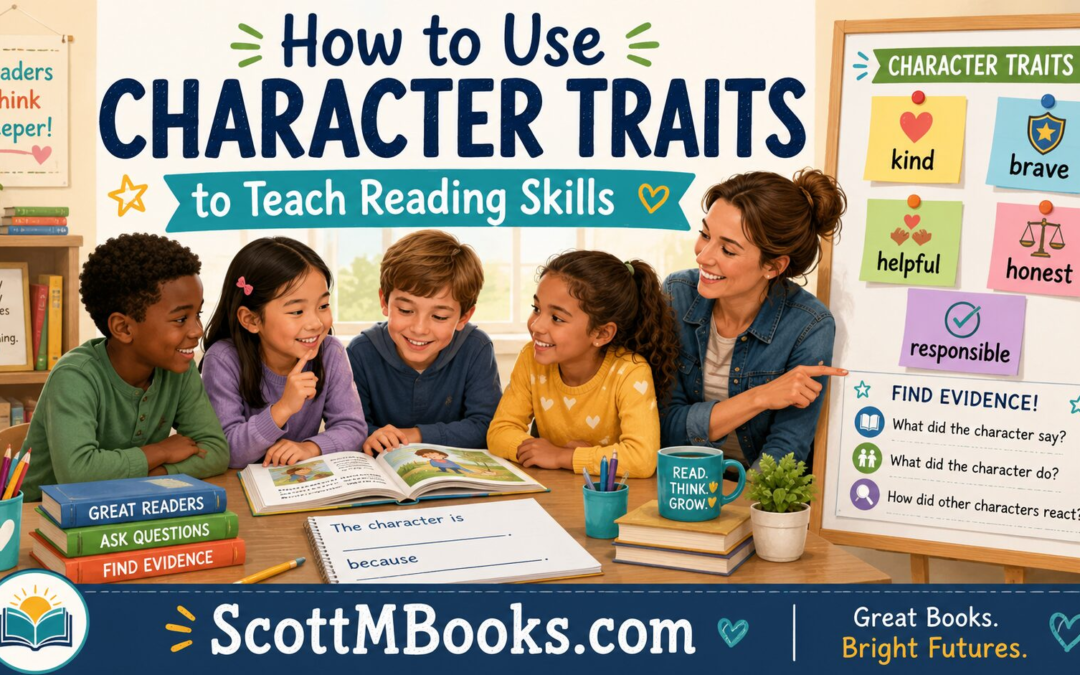
Encourage them to look for evidence in four places:
Actions
What did the character do?
A child who continues practicing after making mistakes may be determined. A character who shares supplies may be generous.
Words
What did the character say?
A sincere apology may show honesty or responsibility. Encouraging words may show kindness.
Thoughts
What was the character thinking?
A character who worries about another person’s feelings may be empathetic, even before taking action.
Choices
What decision did the character make?
Choosing to tell the truth, include someone, ask for help, or correct a mistake can reveal important traits.
Children should learn that traits are not guessed. They are supported by information from the text and illustrations.
Build Vocabulary Through Trait Words
Character discussions help children expand beyond common words such as nice, good, bad, and mean.
Instead of saying a character was nice, children might use:
- Considerate
- Compassionate
- Generous
- Supportive
- Welcoming
- Encouraging
Instead of saying a character was brave, they might use:
- Courageous
- Bold
- Confident
- Adventurous
- Determined
Introduce only a few new words at a time. Explain each word in child-friendly language and connect it to a familiar example.
For instance:
“Considerate means thinking about what another person may need or feel.”
Then ask:
“Which character acted considerately in the story?”
This makes vocabulary meaningful because the new word is connected to a specific person and event.
Compare Traits and Feelings
Children often confuse traits with emotions. A helpful activity is to create two columns:
| Feelings | Character Traits |
|---|---|
| Happy | Cheerful |
| Afraid | Courageous |
| Angry | Impatient |
| Worried | Cautious |
| Excited | Enthusiastic |
| Sad | Compassionate |
Explain that feelings can change quickly. Traits are qualities that appear repeatedly or influence how a character usually behaves.
A courageous character may still feel afraid. A patient character may occasionally feel frustrated. This distinction helps children develop a more accurate understanding of character development.
Use Traits to Teach Cause and Effect
A character’s traits often influence the events of the story.
A responsible character may solve a problem by asking for help. An impatient character may make a rushed decision that creates a new problem. A compassionate character may notice someone who needs support. A determined character may continue working until a goal is reached.
Ask children:
- How did the character’s trait affect the story?
- What happened because the character was patient?
- Did the character’s decision solve or create a problem?
- Would the ending have changed if the character had a different trait?
These questions help children recognize that personality and choices are connected to plot development.
Use Character Traits to Teach Prediction
Once children understand a character’s traits, they can use those traits to make predictions.
Before continuing a story, ask:
- What do you think the character will do next?
- Which trait supports your prediction?
- Would this choice be consistent with the character’s earlier behavior?
- What might cause the character to act differently?
For example:
“Thomas is determined, so I predict he will keep practicing instead of giving up.”
This type of prediction is stronger than a random guess because it is based on evidence.
Explore How Characters Change
Some of the most meaningful stories involve characters who grow or change.
A character may begin the story feeling afraid, selfish, impatient, lonely, or unsure. Through challenges and relationships, the character may become more courageous, responsible, understanding, or confident.
Ask children to compare the beginning and ending:
- What was the character like at the beginning?
- What problem or experience caused the character to change?
- What did the character learn?
- Which new trait did the character develop?
- What evidence shows this growth?
A simple organizer can include:
| Beginning | Important Experience | Ending |
|---|---|---|
| Nervous | Receives encouragement | More confident |
| Selfish | Sees how another person feels | More generous |
| Impatient | Learns that rushing causes problems | More patient |
Character change helps children understand theme, lesson, and personal growth.
Compare Two Characters
Comparing characters strengthens comprehension and analytical thinking.
Children can compare:
- Their traits
- Their choices
- Their feelings
- Their responses to the same problem
- Their relationships with others
- How they change
For example, two characters may both be kind but show kindness differently. One may help through actions, while another uses encouraging words.
A Venn diagram works well:
Character One
- Unique traits
- Unique actions
Both
- Shared traits
- Similar goals
Character Two
- Unique traits
- Different choices
This teaches children that characters can be similar without being identical.
Connect Traits to the Story’s Lesson
Character traits often help reveal what the story teaches.
A character who learns to include others may support a lesson about friendship and belonging. A character who admits a mistake may teach honesty and responsibility. A character who keeps trying may demonstrate perseverance.
Ask:
- Which trait helped the character solve the problem?
- Which trait caused difficulty?
- What did the character learn?
- What lesson can readers learn from the character?
- How could we use that lesson in our own lives?
This moves children from identifying traits to understanding the deeper meaning of the story.
Use Character Traits in Writing Activities
Character analysis can naturally lead to writing practice.
Trait-and-Evidence Paragraph
Children write one paragraph identifying a trait and supporting it with two examples.
“Sally is thoughtful. She notices when Emma is alone and invites her to join the group. She also listens when Emma explains how she feels.”
Character Letter
Children write a letter to a character offering praise, advice, or encouragement.
Change the Trait
Ask children to rewrite a scene with one different character trait.
What would happen if a patient character became impatient? What if a shy character acted confidently?
Character Diary
Children write a diary entry from the character’s point of view, describing feelings, choices, and lessons.
Character Award
Children create an award such as:
- Kindness Champion
- Courage Award
- Most Responsible Character
- Best Problem-Solver
- Most Improved Friend
They must explain why the character deserves it.
Adapt Trait Activities for Different Ages
Younger Children
Use pictures and simple trait words. Ask children to circle a word, point to evidence in an illustration, or draw a scene showing kindness or courage.
Good starter words include:
- Kind
- Brave
- Helpful
- Honest
- Friendly
- Responsible
Early Elementary Readers
Ask children to complete sentence starters:
“The character is __________ because __________.”
They can also match traits to actions or sort examples into categories.
Older Elementary Readers
Encourage children to identify multiple traits, explain changes, compare characters, and support answers with several pieces of evidence.
They can also discuss whether a trait was helpful in one situation but unhelpful in another. Determination, for example, can be positive, but refusing to listen may become stubbornness.
Use a Character Trait Chart
A simple chart can organize the lesson:
| Character Trait | Evidence From the Story | Result |
|---|---|---|
| Kind | Invited a student to join the game | The student felt included |
| Responsible | Asked an adult for help | The situation was handled safely |
| Determined | Continued practicing | The character improved |
| Honest | Admitted making a mistake | Trust was restored |
This chart connects traits, evidence, and consequences.
Discuss Positive and Challenging Traits
Character analysis should not be limited to positive qualities. Children can also examine traits that create problems.
Examples include:
- Impatient
- Dishonest
- Selfish
- Careless
- Stubborn
- Unkind
- Jealous
- Bossy
- Irresponsible
Discuss these words carefully and focus on behavior rather than labeling a person as permanently bad.
Instead of saying, “This is a selfish character,” ask:
“Which action seemed selfish?”
Then discuss whether the character learned, apologized, or changed.
This teaches children that people can make poor choices and still grow.
Use ScottMBooks Characters for Trait Lessons
The characters in stories from ScottMBooks.com provide many opportunities for discussing traits.
Sally’s stories can help children explore friendliness, courage, inclusion, empathy, and responsibility. Lily’s adventures can introduce compassion, safe helping, curiosity, perseverance, and care for animals and the community. Thomas’s experiences can support lessons about determination, honesty, patience, and learning from mistakes. Ben and the Turtle Points stories can help children notice generosity, responsibility, kindness, and the value of small positive actions.
After reading, children might choose three trait words for a character and provide evidence for each one. They can also compare characters from different books or explain how a character’s traits affected the outcome.
Extend the Lesson With Activity Pages
Printable Activity Pages can help children practice character analysis in an organized way.
Useful activities include:
- Character trait charts
- Feelings-and-choices pages
- Trait-and-evidence worksheets
- Compare-and-contrast pages
- Character change organizers
- Story sequencing
- Cause-and-effect exercises
- Writing prompts
- Book reviews
- Kindness challenges
- Responsibility charts
A child might identify one trait, draw the scene that demonstrates it, and write a sentence explaining the evidence. Older readers can write a paragraph or compare traits across several chapters.
Questions to Ask After Reading
Use a few focused questions instead of asking every question at once:
- Which three words describe the main character?
- What did the character do that supports your answer?
- Did the character’s words and actions match?
- Which trait helped solve the problem?
- Which trait created difficulty?
- Did the character change?
- What caused that change?
- Which character would make a dependable friend?
- Which trait would you like to develop?
- What lesson can you learn from the character?
Encourage children to explain their reasoning rather than searching for one perfect answer. Different trait words may be correct when they are supported with strong evidence.
Helping Children Become Deeper Readers
Character traits provide a bridge between basic comprehension and deeper literary thinking. Children begin by identifying what a character is like, but they soon learn to examine evidence, understand motivation, predict behavior, recognize cause and effect, compare perspectives, and explain the story’s lesson.
These skills also extend beyond reading. Children become more aware of emotions, decisions, consequences, relationships, and personal growth.
By regularly discussing character traits, parents, teachers, and homeschool families can help young readers understand not only what happened in a story, but why it happened and what it means. Combined with thoughtful questions and engaging Activity Pages, character study can turn reading time into a meaningful lesson in literacy, reflection, and responsible decision-making.