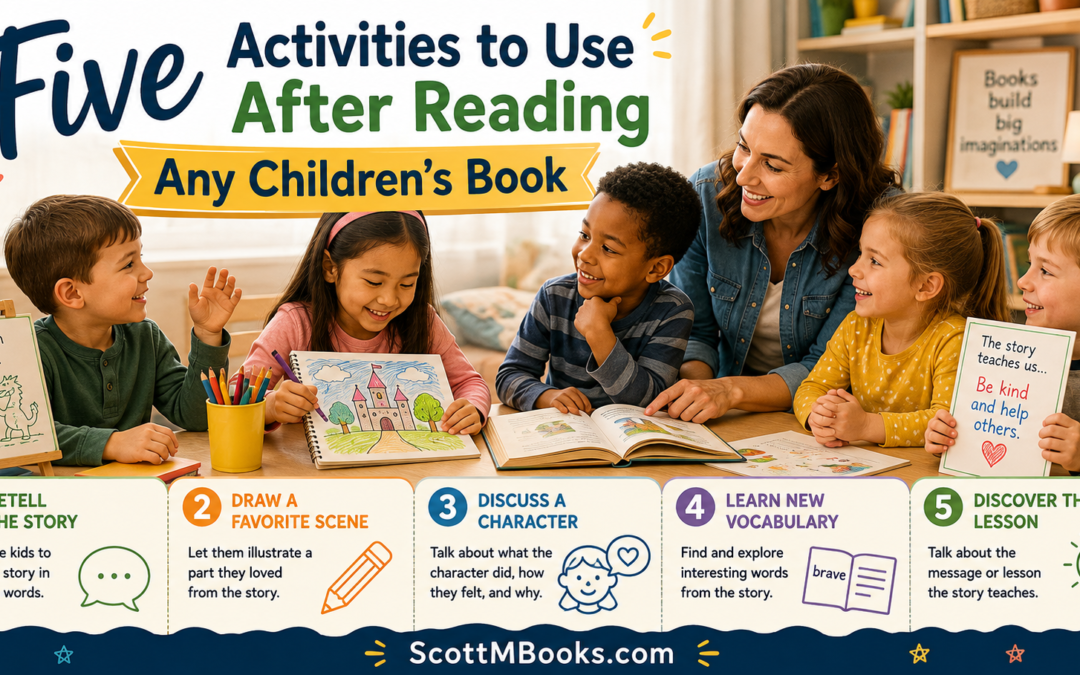
Five Activities to Use After Reading Any Children’s Book
Reading a children’s book is only the beginning of the learning experience. What happens after the final page can help children strengthen comprehension, build vocabulary, practice writing, develop creativity, and think more deeply about a story’s message.
The good news for parents, homeschool families, and teachers is that post-reading activities do not need to be complicated. A few simple exercises can turn almost any children’s book into a meaningful learning opportunity.
Here are five activities you can use after reading almost any children’s book.
1. Retell the Story in Your Own Words
One of the easiest ways to check reading comprehension is to ask a child to retell the story.
Encourage the child to explain what happened at the beginning, middle, and end. Younger children can tell the story aloud, while older students can write a short summary.
You might ask:
- Who were the main characters?
- Where did the story take place?
- What happened first?
- What problem did the character face?
- How was the problem solved?
- How did the story end?
Retelling helps children organize information, remember important details, and distinguish major events from smaller details.
For an additional challenge, ask the child to summarize the entire story in only three or four sentences.
2. Draw and Explain a Favorite Scene
Art can be an excellent way for children to demonstrate what they understood from a story.
Ask the child to choose a favorite scene and draw it. When the picture is finished, have the child explain what is happening and why that scene was important.
Try asking:
Why did you choose this part?
How was the character feeling?
What happened immediately before and after this scene?
Why was this moment important to the story?
The explanation is just as valuable as the drawing. Children practice recalling details, organizing thoughts, and expressing ideas while enjoying a creative activity.
For older students, add a short written paragraph beneath the picture describing the scene.
3. Become a Character Detective
Characters give children an opportunity to think beyond what happened and consider why it happened.
Choose one character from the book and become a “character detective.”
Ask questions such as:
- What kind of person was this character?
- What did the character want?
- What problem did the character face?
- How did the character feel?
- Did the character make a good choice?
- Did the character change during the story?
- What did the character learn?
- What would you have done in the same situation?
This activity helps children recognize character traits, motivations, emotions, problems, and solutions.
It can also lead naturally into conversations about real life. A story about friendship, for example, might encourage a discussion about including others. A story about responsibility could lead to a conversation about chores, schoolwork, pets, or keeping promises.
4. Create a Vocabulary Challenge
Children’s books provide an excellent opportunity to build vocabulary because new words appear within the context of a story.
After reading, choose three to five interesting words from the book.
For each word, ask the child to:
- Say the word aloud.
- Explain what they think it means.
- Look at how the word was used in the story.
- Write or discuss its meaning.
- Use the word in a new sentence.
Younger children can also draw a picture representing each word.
For a fun extension, challenge children to use one or two of their new vocabulary words later in the day.
This helps vocabulary become something children actually use rather than simply memorize.
5. Discover the Story’s Big Lesson
Many children’s books contain a lesson that goes beyond the events of the story.
After reading, ask:
What do you think this story was trying to teach us?
The answer might involve kindness, friendship, courage, patience, honesty, responsibility, confidence, helping others, or making good choices.
Continue the conversation by asking:
- What did the character learn?
- Which choice changed the story?
- Was there a moment when someone showed kindness?
- Did anyone make a mistake and learn from it?
- Could this lesson happen in real life?
- What could we do today that connects with the lesson?
This activity encourages children to move beyond simply remembering the story and begin thinking about its meaning.
You Don’t Need to Do Every Activity
One of the most important things to remember is that reading activities should help children enjoy and understand books—not make every reading experience feel like an assignment.
Choose one activity that fits the child, the book, and the amount of time available.
One day you might simply have a five-minute conversation.
Another day you might complete a drawing and writing activity.
A teacher might use several activities throughout the week, while a homeschool parent might choose one activity each day.
The flexibility is part of what makes children’s books such useful learning tools.
Create a Simple Five-Day Reading Plan
These five activities can also become an easy weeklong reading unit.
Monday – Read and Retell
Read the story and discuss the beginning, middle, and end.
Tuesday – Draw the Story
Create a picture of a favorite or important scene.
Wednesday – Character Detective
Explore a character’s feelings, choices, and actions.
Thursday – Vocabulary Challenge
Choose several interesting words and practice using them.
Friday – Discover the Lesson
Talk or write about what the story teaches and how that lesson connects to everyday life.
With one children’s book and a few simple activities, parents and teachers can create an entire week of meaningful literacy practice.
Turn Reading Into Learning at ScottMBooks.com
At ScottMBooks.com, our children’s stories and activities are designed to help parents, homeschool families, and teachers extend learning beyond the final page.
Children can practice reading comprehension, vocabulary, writing, sequencing, creative thinking, character reflection, and more while exploring important themes such as kindness, friendship, courage, responsibility, compassion, and making good choices.
Whether you are teaching a classroom, homeschooling your children, or simply looking for ways to make family reading time more meaningful, remember that you don’t need an elaborate lesson plan.
Read a story. Ask a question. Start a conversation. Try an activity.
Sometimes those simple moments create the most meaningful learning experiences.