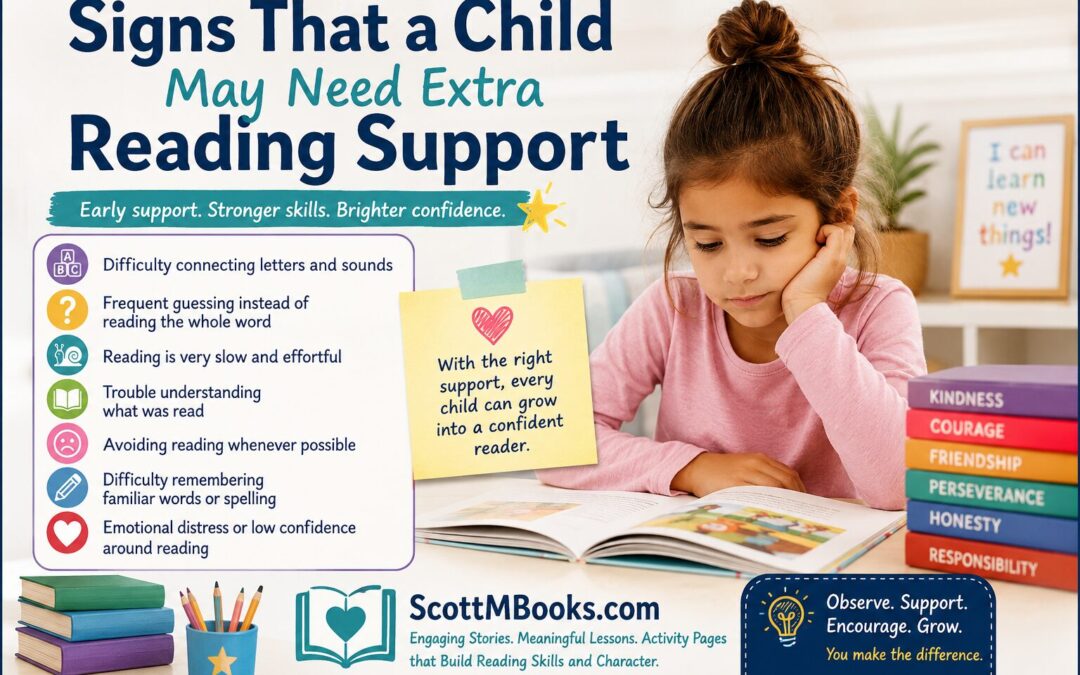
Signs That a Child May Need Extra Reading Support
Children learn to read at different rates. Some recognize words quickly, while others need more repetition, direct instruction, and guided practice. A temporary struggle does not automatically mean that a child has a reading disability. However, when difficulties continue over time, appear in several areas, or cause significant frustration, the child may benefit from additional support.
Recognizing concerns early allows parents, teachers, and homeschool families to respond before reading becomes a source of embarrassment or discouragement. Early identification can create more opportunities for targeted instruction and help prevent reading difficulties from affecting other subjects.
Reading Difficulty Is Not a Sign of Low Intelligence
A child who struggles with reading may be curious, creative, thoughtful, and capable of understanding complex ideas. Reading disorders affect the way a person recognizes, decodes, or understands written language; they do not provide a complete picture of intelligence or potential. Research supported by the National Institutes of Health has also challenged the idea that dyslexia should be identified only when reading performance is unexpectedly low compared with IQ.
Parents should avoid describing a struggling reader as lazy, careless, or unwilling to learn. Reading may require considerably more effort for that child than it does for a sibling or classmate.
The goal is not to assign a label based on a few observations. It is to notice patterns, respond with appropriate instruction, and seek professional guidance when necessary.
1. Difficulty Connecting Letters and Sounds
One early warning sign is persistent difficulty remembering which sounds are represented by particular letters or letter combinations.
A child may:
- Forget letter sounds that have been practiced repeatedly
- Confuse similar-looking letters
- Have trouble identifying the first or last sound in a word
- Struggle to blend separate sounds into a complete word
- Find it difficult to break a spoken word into individual sounds
- Depend heavily on pictures rather than letters
For example, when shown the word map, the child may guess “house” because of the illustration rather than blending the sounds /m/ /a/ /p/.
Problems recognizing speech sounds and connecting them to written letters are among the signs associated with reading disorders.
2. Frequent Guessing Instead of Reading the Entire Word
Beginning readers sometimes use pictures and context to help understand a story. That is normal. A concern may arise when a child consistently guesses words without examining all their letters.
The child may:
- Say a word beginning with the same letter but ignore the rest
- Replace one word with another that would make sense in the sentence
- Use the illustration as the primary way to identify words
- Memorize a book but be unable to read the same words elsewhere
- Rush through unfamiliar words without attempting to sound them out
For example, the child might read horse as “house,” small as “smile,” or puppy as “pet.”
These substitutions may show that the child needs more explicit instruction in decoding—the process of using sound-symbol relationships to read unfamiliar words.
3. Reading Is Very Slow and Effortful
Reading fluency includes accuracy, appropriate pacing, and expression. A child who has not yet developed fluent word recognition may use so much mental energy decoding each word that little attention remains for understanding the passage.
Signs may include:
- Reading one word at a time
- Pausing frequently in the middle of sentences
- Losing their place
- Repeatedly rereading the same line
- Ignoring punctuation
- Reading without natural expression
- Becoming tired after a short passage
- Needing much longer than expected to finish an assignment
Slow reading alone does not confirm a reading disorder, particularly in a child who is just beginning to learn. However, persistent slow or labored reading is one of the symptoms associated with reading difficulties.
4. Difficulty Remembering Familiar Words
A child may successfully read a word during one lesson and appear not to recognize it the next day. Some repetition is expected, but a continuing inability to remember frequently practiced words may signal that the child needs more structured review.
You may notice that the child:
- Has trouble recognizing common words
- Reads the same word differently within one paragraph
- Needs repeated prompts for recently taught patterns
- Relies on memorization but cannot apply the skill to new words
- Becomes confused when a familiar word appears in a new book
Rather than assuming the child was not paying attention, provide additional practice using letters, sounds, spoken words, spelling, and connected text.
5. Ongoing Spelling Difficulties
Spelling provides useful information about how a child understands the sound structure of words. A child who has difficulty hearing sounds or connecting them to letters may also struggle to spell.
Possible signs include:
- Leaving out important sounds
- Reversing the order of sounds
- Spelling the same word several different ways
- Having difficulty spelling simple words that have been practiced
- Writing only the first or most noticeable sound
- Avoiding writing because spelling feels overwhelming
A child might spell train as “tan,” stop as “sop,” or jumped as “jupt.” Not every spelling error is concerning, especially in early writing. The important question is whether the child is gradually learning patterns and applying them more consistently.
Poor spelling commonly appears alongside reading difficulties and may warrant closer attention when it persists despite appropriate instruction.
6. Trouble Understanding What Was Read
Reading comprehension involves more than saying the words correctly. Children must connect ideas, remember important information, make inferences, and understand the meaning of the text.
A child may need additional comprehension support if they frequently have difficulty:
- Naming the main character
- Identifying the setting
- Explaining the central problem
- Retelling events in order
- Recognizing cause and effect
- Answering basic questions
- Identifying the main idea
- Explaining the story’s lesson
- Making a reasonable prediction
- Connecting the text to prior knowledge
Problems understanding what was just read can be one sign of a reading disorder, but comprehension difficulties can have many possible causes.
It is helpful to compare listening comprehension with independent reading comprehension. A child who understands a story when an adult reads it aloud but cannot explain the same type of material after reading independently may be using so much effort to decode that meaning is being lost.
7. Difficulty Retelling Events in Order
A child may remember isolated details but have trouble organizing them into a clear beginning, middle, and end.
You may hear a retelling that:
- Jumps randomly between scenes
- Leaves out the main problem
- Focuses on an unimportant detail
- Confuses what happened first and last
- Does not explain how the problem was solved
- Includes information that was not in the story
Story-sequencing activities can help children organize information and identify relationships between events. Start with three major parts—beginning, middle, and end—before adding more details.
Picture cards, numbered events, oral retelling, and simple story maps can make sequencing more manageable.
8. Avoiding Reading Whenever Possible
Some children do not say, “Reading is difficult for me.” Instead, they communicate through avoidance.
A child may:
- Ask to use the bathroom when reading begins
- Complain of being tired
- Become unusually silly or disruptive
- Request help before attempting the first word
- Choose books far below their listening ability
- Become angry when asked to read
- Hide assignments
- Rush through work carelessly
- Insist that reading is boring
- Prefer any other activity
Avoidance does not always indicate a reading disability. A child may be tired, uninterested in the material, anxious about making mistakes, or unfamiliar with the topic. However, repeated avoidance can signal that reading has become frustrating or embarrassing.
Respond with curiosity rather than punishment. Ask what part feels difficult and observe the child closely during the task.
9. Strong Listening Skills but Weak Independent Reading
Some children understand advanced stories, enjoy rich conversations, and remember detailed information from read-alouds, yet struggle to read much simpler material independently.
This difference may appear when a child:
- Gives thoughtful answers during oral discussions
- Understands grade-level concepts when someone reads aloud
- Has a strong spoken vocabulary
- Tells imaginative stories
- Learns well through videos and demonstrations
- Struggles significantly with printed words
This pattern can indicate that the child’s reasoning and language comprehension are stronger than their decoding skills. Continue providing access to interesting, age-appropriate ideas through read-alouds and audiobooks while directly addressing foundational reading needs.
10. Trouble Following Written Directions
A child may understand instructions when they are spoken but become confused when the same directions appear on a worksheet.
The child might:
- Skip steps
- Begin the wrong task
- Frequently ask what to do
- Complete only part of an assignment
- Misread short directions
- Need instructions repeated aloud
Difficulties following directions, remembering information, paying attention, and staying organized can occur with learning disabilities, although these signs can also result from other factors.
Try reading the directions aloud and asking the child to repeat them in their own words. This can help determine whether the challenge involves reading, language comprehension, attention, memory, or task organization.
11. Reading Problems Affect Other Subjects
As children grow older, reading becomes necessary for learning history, science, mathematics, health, and other subjects. A reading difficulty can therefore appear to be a broader academic problem.
A child may understand a science concept during a demonstration but perform poorly on a written assignment. They may know how to solve a mathematics problem but misread the directions. They may enjoy history discussions but avoid the textbook.
Consider whether the task is truly measuring subject knowledge or whether reading is preventing the child from showing what they understand.
Helpful accommodations may include:
- Reading questions aloud
- Using audiobooks or text-to-speech
- Providing shorter sections
- Previewing vocabulary
- Allowing oral responses
- Using diagrams and demonstrations
- Dividing assignments into smaller steps
These supports can provide access to grade-appropriate content while reading instruction continues separately.
12. Reading Causes Frequent Emotional Distress
Reading difficulty can affect confidence as well as academic performance.
Watch for statements such as:
- “I’m stupid.”
- “Everyone reads better than I do.”
- “I’ll never learn this.”
- “Books are not for me.”
- “I hate school.”
- “Don’t make me read out loud.”
A child may also become tearful, angry, withdrawn, or extremely anxious during reading.
These emotional responses deserve attention even when the child’s test scores do not appear dramatically low. Protecting confidence is an important part of reading support.
Avoid public comparisons, forced performances, and criticism of reading speed. Praise specific strategies and progress:
“You looked at every sound before answering.”
“You corrected that word independently.”
“You remembered the pattern we practiced yesterday.”
“You stayed patient when the sentence was difficult.”
Look for Patterns, Not Isolated Mistakes
Every child occasionally forgets a word, misunderstands a paragraph, or becomes frustrated. A single difficult lesson is not enough to conclude that something is wrong.
Pay closer attention when difficulties are:
- Persistent over time
- Present across different books and settings
- Greater than expected for the instruction received
- Interfering with progress in several subjects
- Causing significant avoidance or distress
- Not improving with additional practice
- Noticeably different from the child’s listening and speaking abilities
Reading disorders can involve different combinations of symptoms, which is why one checklist cannot diagnose a child.
What Parents and Educators Can Do
Observe Carefully
Write down examples of what the child can and cannot do. Note the kinds of words that cause difficulty, how long reading takes, which strategies help, and whether the child understands material read aloud.
Review Foundational Skills
Check letter recognition, sound awareness, blending, decoding, spelling, fluency, vocabulary, and comprehension. A weakness in an earlier skill can affect everything that follows.
Provide Explicit Instruction
Teach skills directly rather than expecting the child to discover every pattern independently. Model the skill, practice it together, and then allow the child to try.
Keep Practice Short and Consistent
A focused lesson followed by successful practice may be more effective than a long session that ends in exhaustion.
Use Appropriate Reading Material
Provide texts that allow the child to practice recently taught patterns, along with rich stories that an adult reads aloud. Instructional reading and reading enjoyment both matter.
Monitor Progress
Save occasional work samples and record which skills have been mastered. If appropriate instruction produces little progress, additional evaluation may be needed.
Evidence-based guidance recommends identifying struggling readers and providing targeted intervention rather than waiting for the difficulty to disappear on its own.
When to Request Additional Help
Parents do not need to wait until a child is failing every subject before seeking guidance. Consider speaking with the child’s teacher, reading specialist, pediatrician, homeschool evaluator, or another qualified professional when reading difficulties persist or cause substantial frustration.
A professional evaluation may examine reading, spelling, language, memory, comprehension, sound processing, and other relevant abilities. No single informal observation or online checklist can diagnose dyslexia or another reading disorder.
Depending on the concern, families may consult:
- A reading specialist
- A school psychologist
- A licensed psychologist or neuropsychologist
- A speech-language pathologist
- A pediatrician
- A qualified dyslexia evaluator
- A special-education professional
The American Academy of Pediatrics advises parents to discuss school struggles with their child’s pediatrician, who may recommend further screening or evaluation.
Using ScottMBooks.com to Support Reading Practice
Books and Activity Pages from ScottMBooks.com can help parents, teachers, tutors, and homeschool families provide enjoyable comprehension practice while observing how children respond to stories.
Stories featuring Sally, Lily, Thomas, Ben, and other ScottMBooks characters can be read independently, shared with an adult, or presented as read-alouds. After reading, children can use the accompanying activities to practice:
- Answering comprehension questions
- Sequencing story events
- Identifying characters and settings
- Exploring character traits
- Discussing feelings and choices
- Learning new vocabulary
- Recognizing cause and effect
- Finding the main idea and lesson
- Writing a short response
- Drawing and explaining a favorite scene
- Reviewing and recommending a book
For a child who needs additional support, adults can adjust the activities without removing the meaning of the lesson. A child may answer orally, use picture cards, draw before writing, complete fewer questions, dictate a response, or work alongside an adult.
ScottMBooks stories and Activity Pages can reinforce vocabulary, comprehension, discussion, and confidence. They are best used as part of a broader reading plan and are not substitutes for specialized foundational instruction or professional evaluation when those are needed.
A Simple Supportive Reading Routine
Try this flexible routine with a ScottMBooks story or another engaging children’s book:
Before Reading
Look at the title and cover. Introduce two or three important vocabulary words and ask the child to make a prediction.
During Reading
Share the reading when appropriate. Pause briefly to clarify unfamiliar words, discuss a character’s feelings, or ask what may happen next.
After Reading
Ask the child to identify:
- The main character
- The setting
- The problem
- Three important events
- The solution
- The lesson
Then choose one Activity Page. Avoid assigning several pages simply because they are available. A focused, successful activity is usually more valuable than a large amount of rushed work.
Helping Children See Themselves as Readers
A child who needs extra reading support should continue to experience books as sources of enjoyment, imagination, knowledge, and connection. Continue reading aloud, visiting libraries, exploring favorite subjects, discussing stories, and celebrating progress.
Do not measure a child’s potential by reading speed or spelling accuracy alone. Notice curiosity, creativity, humor, problem-solving, kindness, memory, artistic ability, scientific interest, and the many other strengths that contribute to learning.
Recognizing a reading difficulty is not about defining a child by a weakness. It is about discovering what kind of instruction and support will help that child move forward.
With careful observation, appropriate teaching, meaningful practice, encouragement, and professional guidance when needed, struggling readers can develop stronger skills without losing their confidence or love of learning.