Reading Activities for Children With Short Attention Spans
Reading can be difficult for children who have trouble sitting still, concentrating for long periods, or following an extended story. A child may begin with enthusiasm but lose interest after a few pages, become distracted by nearby objects, interrupt frequently, or avoid reading altogether.
These behaviors do not necessarily mean that a child dislikes books or cannot become a strong reader. Some children simply learn better through shorter lessons, movement, visual support, active participation, and frequent opportunities to respond.
Parents, teachers, and homeschool families can make reading more successful by adjusting the activity rather than expecting every child to sit quietly for a long lesson. The goal is to create positive reading experiences that gradually strengthen attention, comprehension, vocabulary, and confidence.
Begin With Short, Successful Reading Sessions
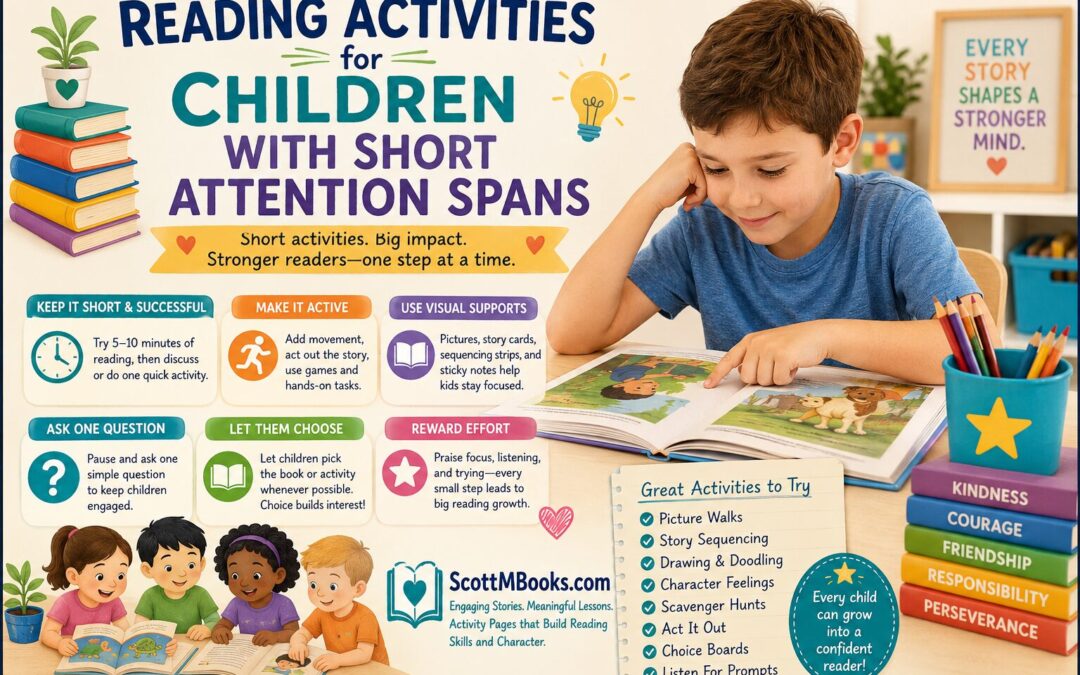
A child does not need to read for thirty or forty minutes at one time to benefit from books. For some learners, five to ten focused minutes can be more productive than a longer session filled with frustration.
Begin with an amount of time the child can manage successfully. End the activity while the child is still participating rather than waiting until attention has completely disappeared.
A simple routine might include:
- Five minutes of reading
- Two minutes of discussion
- One short Activity Page
- A movement break
- Another brief reading period later in the day
Several short sessions can provide just as much meaningful practice as one long lesson.
As the child becomes more comfortable, gradually increase the reading time. Add only a few minutes at a time and continue watching for signs of fatigue or frustration.
Choose Books That Capture the Child’s Interest
Children are more likely to focus when the story connects with something they already enjoy.
Look for books featuring:
- Animals
- Friendship
- Sports
- Humor
- Adventures
- School experiences
- Family life
- Nature
- Mysteries
- Favorite hobbies
A child who struggles to focus on a general reading assignment may pay close attention to a story about puppies, bicycles, turtles, farms, or making new friends.
Whenever possible, allow the child to choose between two or three appropriate books. A small choice gives the child a sense of ownership without making the decision overwhelming.
Books from ScottMBooks.com feature relatable characters such as Lily, Sally, Thomas, and Ben. Their adventures explore pets, friendship, kindness, school, responsibility, nature, courage, and everyday choices—topics that can help children connect emotionally with what they are reading.
Preview the Story Before Reading
Children with short attention spans may find it easier to follow a story when they already know what to expect.
Before reading, spend a minute looking at:
- The cover
- The title
- The characters
- The setting
- Two or three illustrations
- One important vocabulary word
Ask a simple prediction question:
“What do you think may happen in this story?”
This brief preview gives the child a purpose for listening. The child can read or listen to discover whether the prediction was correct.
Avoid explaining the entire story in advance. The purpose is to provide direction, not remove all curiosity.
Use a Picture Walk
A picture walk allows children to look through the illustrations before hearing the complete story.
Ask the child to describe what they notice:
- Who is in the picture?
- Where are the characters?
- What seems to be happening?
- How might the character feel?
- What could happen next?
This activity is especially useful for young readers and children who need visual support. It builds interest while activating background knowledge.
After the picture walk, return to the beginning and read the story. Children often focus more carefully because they want to learn how the pictures connect.
Read One Page and Ask One Question
Long lists of questions can make reading feel like a test. Instead, pause after one or two pages and ask a single, focused question.
Examples include:
- What just happened?
- Who is helping?
- How does the character feel?
- What do you think will happen next?
- Was that a good choice?
- What would you do?
These brief pauses give children an active role. They also allow adults to check understanding before continuing.
Do not stop after every sentence. Too many interruptions can make it difficult to enjoy the story. Choose natural stopping points where an important decision, problem, or change occurs.
Let the Child Move While Listening
Some children concentrate better when their bodies are allowed to move. Requiring complete stillness can use so much energy that little attention remains for the story.
During a read-aloud, a child might:
- Sit on a cushion
- Rock gently
- Hold a quiet fidget
- Stand beside the table
- Draw a picture related to the story
- Build with a small number of blocks
- Act out simple motions
- Point to illustrations
The movement should support listening rather than become a separate activity that takes over the lesson.
For example, children can touch their heads whenever they hear a character’s name or hold up a picture card when an important event occurs.
Add Movement to the Story
Reading activities can involve the whole body.
Try asking children to:
- Pretend to walk like the character
- Act out an emotion
- Move to different parts of the room for beginning, middle, and end
- Jump once for a true statement and remain still for a false statement
- Place event cards around the room in the correct order
- Find a vocabulary word posted on the wall
- Act out a problem and solution
Movement can turn review into an active learning experience while reinforcing comprehension.
A child studying story sequence might carry four event cards to different locations and arrange them from first to last. This keeps the child physically engaged while practicing an important reading skill.
Use Story Sequencing Cards
Story sequencing is especially useful for children who need short, hands-on tasks.
Choose three to five important events from the story. Write or illustrate each event on a separate card. Ask the child to place the cards in the correct order.
Begin with:
- First
- Next
- Then
- Last
The child can then use the cards to retell the story.
For younger children, use pictures. Older children can read short event descriptions or write the events themselves.
Sequencing cards strengthen memory, comprehension, cause-and-effect understanding, and oral language without requiring a long written assignment.
Try a Reading Scavenger Hunt
Turn the story into a search activity.
Ask the child to find:
- A character showing kindness
- A picture of the setting
- A word beginning with a particular letter
- An example of a good choice
- Something that made a character nervous
- The event that caused the problem
- The page where the problem was solved
Children can use sticky notes or small bookmarks to mark each discovery.
A scavenger hunt gives reading a clear purpose and can be completed in short sections.
Use “Listen For” Prompts
Before reading a page or chapter, give the child one detail to listen for.
For example:
“Listen for the moment when Sally notices someone needs a friend.”
“Listen for the choice Lily makes when she needs help.”
“Listen for a word that means brave.”
“Listen for the problem Thomas must solve.”
The child is more likely to focus when there is one specific idea to find.
Afterward, ask the child to explain what they heard. This reinforces attention and comprehension without requiring constant correction.
Let Children Draw While Listening
Drawing can help some children remain engaged during a read-aloud.
Give the child one focused prompt:
- Draw the setting.
- Draw your favorite character.
- Draw the main problem.
- Draw what you think will happen next.
- Draw the most important scene.
- Draw a different ending.
After reading, ask the child to explain the picture.
The explanation is an important part of the activity. It helps the child connect the drawing to the text and demonstrate understanding.
Avoid requiring a perfect picture. The goal is thoughtful engagement, not artistic accuracy.
Use Character Feeling Cards
Create simple cards showing feelings such as:
- Happy
- Sad
- Nervous
- Excited
- Angry
- Lonely
- Proud
- Confused
While reading, ask the child to choose the card that matches the character’s feelings.
Then ask:
“What happened that made the character feel that way?”
This activity supports emotional awareness and reading comprehension. It is also short enough to maintain interest.
Children can change the card as the character’s feelings change throughout the story.
Act Out Character Choices
Stories often present characters with decisions. Acting out those moments helps children understand the options and consequences.
Pause before the character makes an important choice and ask:
“What could the character do?”
Act out two possibilities. Then discuss which choice is:
- Kind
- Safe
- Responsible
- Honest
- Helpful
After reading the story, compare the child’s idea with the choice the character actually made.
This activity works especially well with ScottMBooks stories about friendship, inclusion, caring for animals, asking adults for help, completing responsibilities, and learning from mistakes.
Use a Reading Response Choice Board
A choice board allows children to select one brief activity after reading.
Possible choices include:
- Draw a favorite scene.
- Name three important events.
- Act out the ending.
- Describe the main character.
- Choose one new vocabulary word.
- Explain the lesson.
- Give the book a rating.
- Create a new title.
- Tell what you would do differently.
Limit the board to four or six choices at one time. Too many options may become distracting.
The child completes only one response unless they are eager to continue.
Break Activity Pages Into Smaller Sections
A full worksheet can look overwhelming to a child with a short attention span. Cover part of the page with another sheet of paper and reveal one section at a time.
Instead of saying, “Complete the whole page,” say:
“Let’s answer the first two questions.”
After those are finished, provide praise, take a brief break, and decide whether to continue.
ScottMBooks Activity Pages can be adjusted in this way. A child might complete:
- Two comprehension questions
- One vocabulary word
- One sequencing activity
- One character reflection
- One drawing prompt
It is not necessary to use every page after every book. Select the activity that best supports the lesson.
Use Sticky Notes for Quick Responses
Sticky notes provide a less intimidating alternative to a full worksheet.
Ask the child to write or draw:
- One character
- One important event
- One new word
- One feeling
- One lesson
- One question
Place the notes on a wall, poster, or Story Board.
At the end, arrange them into categories such as character, setting, problem, solution, and lesson.
This makes comprehension visible and hands-on.
Read Together in Different Ways
Reading does not always have to follow the same format.
Try rotating among:
Echo Reading
The adult reads one sentence with expression, and the child repeats it.
Choral Reading
The adult and child read the passage together.
Partner Reading
The adult reads one page and the child reads the next.
Character Reading
Each reader takes the dialogue of a different character.
Shared Read-Aloud
The adult reads while the child follows along and discusses the story.
These formats can reduce pressure and add variety.
For a child who finds independent reading tiring, the adult can read most of the text while inviting the child to read one repeated sentence, a speech bubble, or a short section.
Turn Vocabulary Into a Game
Vocabulary practice can be brief and active.
Choose three new words from the story. Write each word on a card.
Then ask the child to:
- Match the word to a picture
- Act out the meaning
- Use it in a sentence
- Find it in the book
- Choose between two possible definitions
- Draw the word
- Sort words by feeling, action, or description
Reviewing only a few words at a time is usually more effective than presenting a long list.
Use the words again later in conversation so the child hears them in meaningful contexts.
Create a “Stop and Retell” Routine
After a short section, close the book and ask the child to retell what happened.
Provide a structure:
“First…”
“Then…”
“The problem was…”
“I think next…”
The retelling can be only one or two sentences.
This routine helps children hold information in memory and prevents them from reaching the end of a story without understanding the earlier events.
Use a Simple Timer Carefully
A visual timer can help some children understand that the reading activity has a clear beginning and end.
You might say:
“We will read together for eight minutes, and then we will take a movement break.”
Keep the time achievable. The timer should provide reassurance, not pressure.
Avoid using it to rush the child’s reading. The goal is to create a predictable work period rather than measure how many words the child can finish.
Plan Purposeful Breaks
Breaks are most effective when they are planned before the child becomes overwhelmed.
A short break might include:
- Stretching
- Getting a drink
- Walking across the room
- Completing five jumping jacks
- Feeding a pet
- Looking out the window
- Taking several slow breaths
Keep the break brief and predictable. Afterward, return to one clearly defined task.
A pattern such as “read, respond, move, return” can work well for children who need frequent changes.
Reduce Unnecessary Distractions
The reading environment can affect attention.
Before beginning:
- Turn off the television.
- Silence unnecessary notifications.
- Remove unrelated toys from the table.
- Gather materials in advance.
- Use a comfortable, well-lit area.
- Keep only the current book and activity visible.
The space does not need to be silent or look like a formal classroom. It simply needs to reduce competing demands on the child’s attention.
Some children concentrate best at a desk, while others prefer a couch, floor cushion, reading tent, or outdoor space.
Offer Specific Encouragement
General praise such as “Good job” is pleasant, but specific feedback teaches the child what was successful.
Try saying:
- “You listened carefully for the important event.”
- “You remembered what happened first and last.”
- “You used the picture and the words to explain your answer.”
- “You returned to the story after your break.”
- “You noticed how the character’s feelings changed.”
- “You finished the activity without rushing.”
Recognize effort, strategy, and progress—not only correct answers.
Avoid Turning Reading Into a Punishment
Children who already find reading difficult may develop stronger resistance when books are used as a consequence.
Avoid statements such as:
“Since you did not finish your chores, you have to read for thirty minutes.”
Reading should be associated with discovery, connection, stories, and growth.
This does not mean children should never complete challenging work. It means reading should not be presented as something unpleasant that happens when they make a mistake.
Follow the Child’s Strengths
A child with a short attention span may have strong abilities in other areas. They may be imaginative, verbal, artistic, active, humorous, curious, or skilled at building and problem-solving.
Use those strengths during reading.
A creative child can illustrate a scene. An active child can act out events. A verbal child can record an audio review. A child who likes building can create the setting with blocks. A child interested in animals can research an animal from the story.
Reading becomes more meaningful when it connects with what the child already does well.
A 20-Minute Reading Routine
Here is a simple routine for a child who benefits from short activities.
Minutes 1–3: Preview
Look at the cover, introduce one vocabulary word, and make a prediction.
Minutes 4–10: Read
Read a short section together. Pause once to discuss an important event.
Minutes 11–13: Move
Stretch, act out a scene, or place sequencing cards around the room.
Minutes 14–18: Respond
Complete one Activity Page section, draw a scene, or retell the story.
Minutes 19–20: Celebrate and Preview
Name one thing the child did well and briefly explain what will happen during the next reading session.
This routine can be shortened or divided into two parts when necessary.
Using ScottMBooks.com Stories and Activity Pages
ScottMBooks stories are designed to combine enjoyable reading with meaningful lessons about kindness, friendship, courage, responsibility, empathy, inclusion, perseverance, and making good choices.
For children with short attention spans, adults can use the stories in small sections rather than reading an entire book at once.
Try this approach:
- Preview the chapter or story.
- Read for five to ten minutes.
- Ask one discussion question.
- Complete one active response.
- Take a short break.
- Return later for the next section.
The accompanying Activity Pages can reinforce:
- Reading comprehension
- Story sequencing
- Vocabulary
- Character traits
- Feelings and choices
- Cause and effect
- Main idea and lesson
- Creative writing
- Drawing and reflection
Select one or two activities that match the child’s needs. A smaller amount of focused work is more valuable than several pages completed without attention or understanding.
When Attention Difficulties Continue
Children have different attention spans, and concentration can vary depending on age, sleep, interest, environment, stress, and the difficulty of the task.
Parents and educators should pay closer attention when concentration problems are persistent, occur in many settings, interfere significantly with learning, or cause frequent emotional distress.
Keep notes about:
- When attention is strongest
- Which activities are most difficult
- How long the child can work successfully
- Whether movement improves focus
- Whether reading is harder than other subjects
- Which strategies help
- Whether the child understands material read aloud
These observations can help parents, teachers, reading specialists, or other qualified professionals determine what additional support may be appropriate.
Helping Children Build Reading Stamina
Reading stamina develops gradually. A child who focuses for seven successful minutes today may be able to manage ten minutes after consistent practice.
The goal is not to force longer sessions as quickly as possible. It is to help the child experience repeated success.
Short lessons, engaging books, movement, visual activities, manageable Activity Pages, meaningful choices, and specific encouragement can transform reading time. Instead of feeling overwhelmed, children begin to see themselves as active participants who can understand stories, discuss ideas, and grow as readers.
At ScottMBooks.com, stories and educational activities help families and educators make reading more engaging, flexible, and purposeful. By adapting each lesson to the child’s attention, interests, and strengths, adults can build comprehension and confidence—one successful reading experience at a time.