Mia’s Good Idea Book: Helping Children Learn to Think, Plan, and Solve Problems
Free eBooks and Activity pages ScottMbooks.com
Children face small problems every day.
They forget where they put something. A plan does not work the first time. They misunderstand a friend. They become frustrated when they cannot find an answer right away.
These everyday moments are opportunities to teach children how to slow down, think carefully, ask for help, and try again.
That is the idea behind Mia’s Good Idea Book, an important part of the story Mia and the Lost Lunchbox.
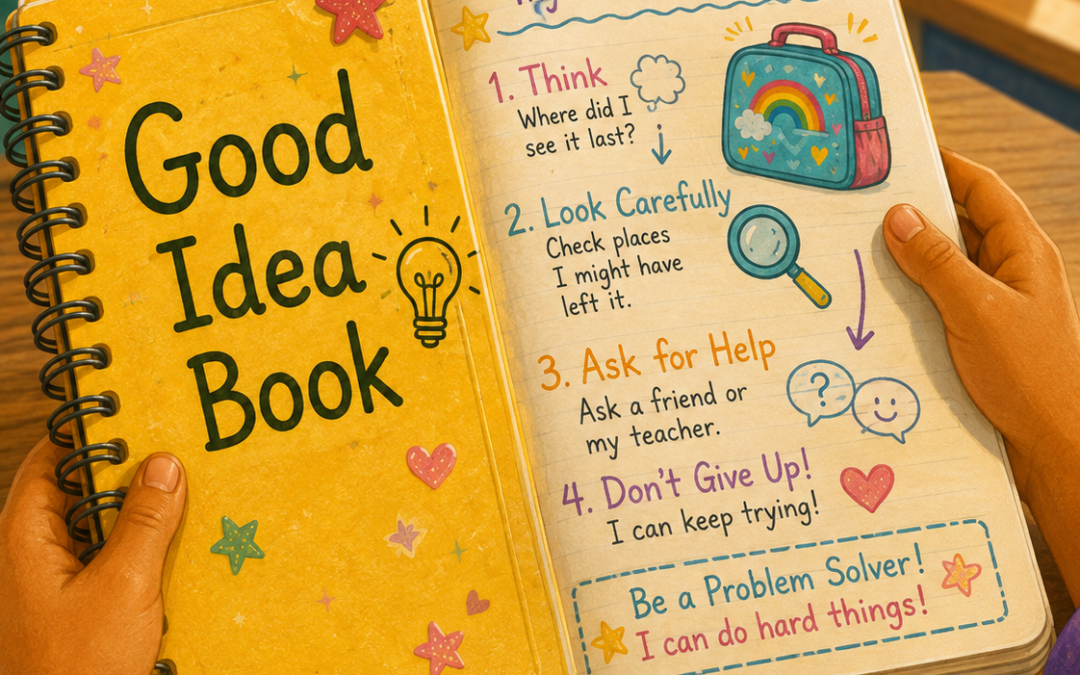
Mia’s Good Idea Book is more than a notebook. It represents a simple way of thinking that young children can use whenever they face a problem:
Stop. Think. Make a plan. Try one small step.
What Is Mia’s Good Idea Book?
Mia is a curious young girl who enjoys solving problems.
Whenever she has a question, an idea, or something she needs to figure out, she turns to her bright yellow Good Idea Book.
She might use it to:
- Write down a problem
- Make a simple plan
- Draw a picture
- Record clues
- Ask questions
- Make a list
- Think about what worked
- Write down what she learned
Sometimes Mia’s ideas work right away.
Sometimes they do not.
That is an important part of the Good Idea Book.
The goal is not to teach children that every first idea will be successful. The goal is to show them that when something does not work, they can think again and try another step.
How the Good Idea Book Helps Mia
In Mia and the Lost Lunchbox, Mia discovers that her special lunchbox is missing at school.
At first, she becomes worried.
She looks in her backpack.
She checks her desk.
She checks her cubby.
Still no lunchbox.
Instead of searching everywhere at once, Mia remembers her Good Idea Book.
She opens it and begins thinking about what she already knows.
She remembers bringing the lunchbox to school.
She remembers going to the school office.
She remembers stopping near the library.
Those memories become the beginning of a plan.
Mia’s Good Idea Book helps turn a big, confusing problem into smaller steps.
One Small Step at a Time
One of Mia’s favorite ideas is:
“Let’s make a plan—and try one small step.”
This message helps young children because problems can feel overwhelming.
A child who cannot find a homework paper may think:
“It’s gone!”
A child struggling with a reading assignment may think:
“I can’t do this!”
A child who has a disagreement with a friend may think:
“Everything is ruined!”
Mia’s approach offers another possibility.
Instead of trying to solve everything at once, ask:
What is one small thing I can do next?
That might mean checking one place.
Asking one question.
Talking to one adult.
Trying one different idea.
Reading one more sentence.
One small step can make a difficult situation feel more manageable.
The Good Idea Book Encourages Problem-Solving
Problem-solving is an important skill in both school and everyday life.
Mia’s notebook encourages children to think through questions such as:
What is the problem?
What do I already know?
What could I try?
Who could help me?
Did my idea work?
What should I try next?
What did I learn?
You can use these questions in many different situations.
The problem does not have to be a lost lunchbox.
A child might use the same process when:
- A toy goes missing
- A school assignment feels difficult
- A classroom project does not work
- A friend misunderstands something
- A child forgets something important
- A new activity feels challenging
The Good Idea Book gives children a framework for thinking, not immediately reacting.
It Teaches That Asking for Help Is Smart
Mia does not solve the lunchbox mystery completely on her own.
She asks classmates what they remember.
She talks with her teacher.
She gets information from adults at school.
Each person provides another small piece of information.
This helps children understand an important lesson:
Good problem-solvers know when to ask for help.
Asking for help does not mean giving up.
It means using the people and resources around you wisely.
Parents and teachers can reinforce this by asking:
“Who could help you with this?”
“Is there someone who might know something you do not?”
“Would an adult need to help with this problem?”
These questions also reinforce safe helping and responsible decision-making.
The Good Idea Book Builds Patience
Mia wants her plan to work quickly.
Like many young children, she can become impatient when the answer does not appear right away.
But the missing lunchbox teaches her that solving a problem may take more than one try.
Her first search does not work.
So she tries another idea.
Then another.
Eventually, the clues begin to fit together.
This creates an important message for children:
A plan can still be useful even when it does not solve the problem immediately.
Sometimes an unsuccessful attempt teaches us something.
Mia may not find the lunchbox in the classroom, but now she knows one place where it is not.
That is still progress.
It Helps Children Learn From Mistakes
The Good Idea Book also becomes a place for Mia to reflect.
After the lunchbox mystery is solved, Mia does not simply move on.
She asks:
What worked?
What could I do differently next time?
She learns to put her name on her lunchbox and keep it in the same place.
That turns a mistake into a new routine.
This is one of the most useful lessons children can learn:
A mistake can teach us how to make a better plan.
Instead of focusing only on what went wrong, children can begin asking:
“What did I learn?”
Create Your Own Good Idea Book at Home
Parents can easily create a Good Idea Book with their children.
You do not need anything complicated.
Use a small notebook, journal, or several sheets of paper stapled together.
Let your child decorate the cover.
Write:
MY GOOD IDEA BOOK
Then create a few simple pages.
My Problem
What happened?
What I Know
What do I already know about the problem?
My Ideas
What could I try?
Who Can Help?
Is there someone I can ask?
What Happened?
Did my plan work?
What I Learned
What would I do next time?
Younger children can draw instead of writing full sentences.
The important part is the thinking process.
Use a Good Idea Book in the Classroom
Teachers can also use Mia’s idea as a classroom activity.
Students could keep a small Problem-Solving Journal or Good Idea Book in their desk.
They might use it during reading, writing, STEM activities, group work, or character-education lessons.
Students could record:
- A prediction before reading
- A question they have
- A difficult vocabulary word
- A problem a character faces
- A possible solution
- Something they want to try
- Something they learned from a mistake
This can help students become more independent thinkers while also giving teachers insight into how they approach problems.
Use It After Reading a Story
The Good Idea Book concept works especially well as a reading-response activity.
After reading a children’s story, ask students to imagine that the main character has a Good Idea Book.
Then ask:
What problem would the character write down?
What plan would the character make?
What mistake did the character learn from?
What advice should the character write for next time?
This can be used with many different books and encourages children to think more deeply about characters and choices.
A Good Idea Book Can Also Support Writing
The notebook can become a place for creativity too.
Children might use it to:
- Invent a new story ending
- Draw a new character
- Write a question for an author
- Create a list of kindness ideas
- Design a solution to a problem
- Record new vocabulary
- Write a goal
- Plan a story of their own
That makes the Good Idea Book useful for both academic learning and imagination.
Mia’s Good Idea Book and Character Development
The Good Idea Book also connects with many of the values explored through ScottMBooks stories.
Children can use it to think about:
Kindness — How could I help someone?
Responsibility — What should I remember next time?
Patience — What can I do if my first idea does not work?
Courage — What small step can I take even if I feel unsure?
Friendship — How can I solve a misunderstanding?
Honesty — What should I do if I make a mistake?
Confidence — What have I already learned that can help me?
This gives children a practical way to connect character lessons with everyday situations.
Try Mia’s Problem-Solving Questions
The next time your child or student faces a small problem, try asking:
What happened?
What do you know?
What could you try first?
Who could help?
What happened when you tried?
What could you try next?
What did you learn?
These questions encourage children to become active participants in solving problems instead of waiting for an adult to provide every answer.
Good Ideas Grow With Practice
Mia’s Good Idea Book works because it gives children permission to think, experiment, make mistakes, and try again.
It does not promise that every problem will be easy.
It teaches something more useful:
You can begin.
You can take one step.
You can ask a question.
You can make a plan.
You can get help.
You can learn from what happens next.
At ScottMBooks.com, stories like Mia and the Lost Lunchbox are designed to help children strengthen reading skills while also exploring practical lessons about problem-solving, responsibility, patience, kindness, and confidence.
And sometimes the best way to solve a big problem is exactly what Mia says:
“Let’s make a plan—and try one small step.”
Suggested Call-to-Action
Explore Mia and the Lost Lunchbox
Discover Reading Activities for Mia’s Story
Create Your Own Good Idea Book
Visit ScottMBooks.com for More Stories and Learning Resources