Helping Children Learn from a Character’s Mistakes
Children’s stories are filled with characters who make mistakes. They may say the wrong thing, ignore good advice, hurt someone’s feelings, make a poor choice, or act before thinking.
Those moments can become some of the most valuable parts of a story.
When children see a character make a mistake and then face the consequences, they have an opportunity to think about choices in a safe and comfortable way. Instead of being told what they should or should not do, children can watch a character struggle, reflect, change, and grow.
For parents, homeschool families, and teachers, these story moments can open the door to meaningful conversations about responsibility, empathy, problem-solving, forgiveness, and making better choices.
Mistakes Make Characters More Relatable
Perfect characters are not always the most interesting or helpful.
Children often connect more strongly with characters who experience the same kinds of challenges they do. A character might become jealous, feel left out, lose patience, forget a responsibility, misunderstand a friend, or make a decision they later regret.
These imperfections make characters feel real.
When children recognize themselves in a character, they may become more willing to talk about what happened and consider what they might do in a similar situation.
A simple question such as:
“Have you ever felt the way this character felt?”
can turn a story into a valuable personal connection.
Focus on the Choice, Not Just the Mistake
When discussing a character’s mistake, try to avoid simply labeling the character as “good” or “bad.”
Instead, focus on the choice.
Ask:
- What choice did the character make?
- Why do you think the character made that choice?
- What happened because of it?
- Who was affected?
- What could the character have done differently?
- What might be a better choice next time?
This approach teaches children an important lesson: making a poor choice does not define a person. What matters is recognizing the mistake, taking responsibility, and learning from it.
Help Children Understand Cause and Effect
Stories provide a natural way to teach cause and effect.
A character makes a decision, and something happens as a result.
For example:
Choice: A character refuses to share.
Result: Another child feels excluded.
Or:
Choice: A character ignores an adult’s instructions.
Result: The character creates a problem that could have been avoided.
Ask children to identify both the choice and the consequence.
You can say:
“What happened because the character made that decision?”
Then follow with:
“What might have happened if the character had made a different choice?”
These questions encourage children to think ahead and consider how actions can affect both themselves and other people.
Talk About Feelings on Both Sides
A character’s mistake often affects more than one person.
Encourage children to think about how everyone involved might feel.
Ask questions such as:
- How did the character feel before making the choice?
- How did the character feel afterward?
- How did the other person feel?
- Did the character understand how their actions affected someone else?
- What could the character do to make things better?
This type of discussion helps children practice empathy by looking at a situation from more than one point of view.
Ask, “What Could the Character Do Next?”
One of the best questions to ask after a character makes a mistake is:
“What should happen next?”
Children might suggest:
- Saying sorry
- Telling the truth
- Fixing something that was damaged
- Including someone who was left out
- Asking for help
- Trying again
- Making a different choice the next time
This shifts the discussion from the mistake itself to repair and growth.
Children begin to understand that mistakes can become opportunities to learn.
Use “What Would You Do?” Questions
Stories allow children to practice decision-making without facing the real consequences of the situation.
Pause during or after a story and ask:
“What would you do if you were this character?”
You can also provide choices:
“Would you walk away, ask for help, talk to your friend, or try something else?”
Then ask the child to explain why.
There may be several reasonable answers. The important part is encouraging children to think about their choices and explain their reasoning.
Turn the Mistake Into a Writing Activity
For children who are ready for writing practice, a character’s mistake can become an excellent prompt.
Try one of these:
A Better Choice
Write about what the character could have done differently.
Dear Character
Write a short letter giving the character advice.
Try Again
Rewrite the scene so the character makes a better choice.
What Happens Next?
Write about how the character could repair the situation.
My Connection
Write about a time you made a mistake and learned something from it.
These activities strengthen writing skills while encouraging reflection and critical thinking.
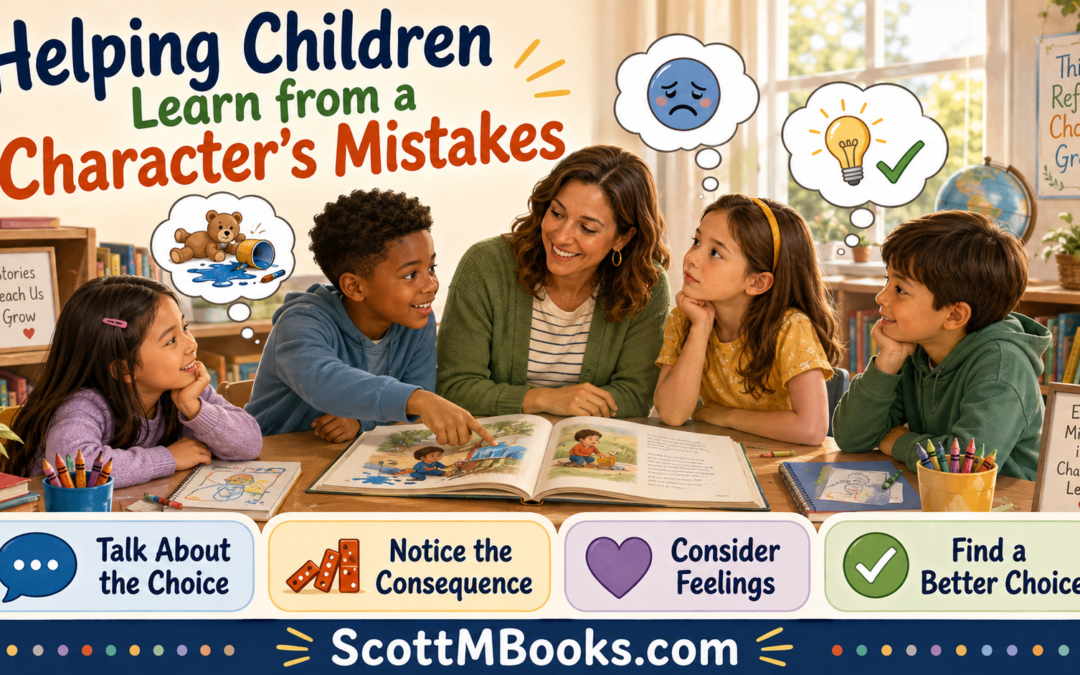
Create a Simple “Mistake and Lesson” Chart
A quick activity for home or the classroom is to divide a page into four sections:
The Mistake
What did the character do?
The Result
What happened because of the choice?
A Better Choice
What could the character have done differently?
The Lesson
What can we learn from what happened?
This activity works with almost any children’s story and can be adapted for different reading levels.
Younger children can answer aloud or draw pictures, while older students can write complete responses.
Teach That Learning Often Comes From Mistakes
One of the most useful lessons children can take from literature is that people do not always get everything right the first time.
Characters may misunderstand a situation, make a selfish decision, become afraid, lose their temper, or fail at something they are trying to accomplish.
What makes the story meaningful is often what happens afterward.
Does the character admit the mistake?
Does someone help?
Does the character try again?
Does the character apologize?
Does the character learn something?
These are the moments where growth takes place.
Connect Story Lessons to Everyday Life
After discussing the character, gently bring the lesson into the child’s world.
You might ask:
- Has something like this ever happened at school?
- What could someone do if a friend felt left out?
- What should you do if you realize you made a mistake?
- Why can apologizing sometimes be difficult?
- How can we make things better after hurting someone’s feelings?
Keep the conversation general rather than turning the story into a lecture about something the child has done.
Children are often more willing to think openly when they do not feel that they are being criticized.
Stories Give Children a Safe Place to Practice Life Skills
Children’s books do much more than teach reading.
Through characters and their experiences, children can explore difficult situations, consider different choices, understand consequences, and imagine better ways to respond.
A character’s mistake can become a lesson about:
Kindness • Responsibility • Friendship • Courage • Empathy • Honesty • Patience • Forgiveness • Problem-Solving • Making Better Choices
At ScottMBooks.com, stories and activities are designed to help parents, homeschool families, and teachers use reading as a starting point for meaningful learning and conversation.
The next time a character makes a mistake, do not rush past it.
Ask what happened.
Ask why it happened.
Ask what could have been done differently.
And most importantly, ask:
“What can we learn from this?”
Sometimes a character’s worst decision can lead to one of a story’s best lessons.