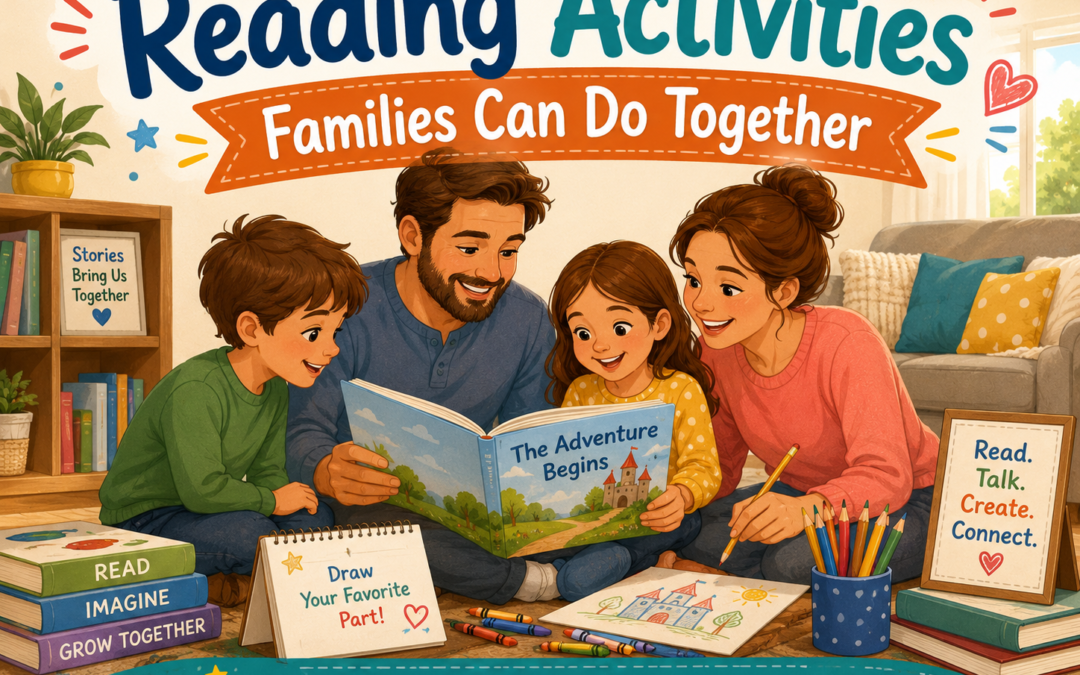
Reading Activities Families Can Do Together
Reading together as a family can be about much more than finishing a book. A shared story can lead to conversations, drawings, games, writing activities, vocabulary practice, and meaningful discussions about kindness, responsibility, friendship, courage, and other important life lessons.
The best part is that family reading activities do not have to feel like schoolwork. With a few simple ideas, parents and children can turn an ordinary story into enjoyable time spent reading, thinking, creating, and learning together.
Here are some easy activities families can use with almost any children’s book.
1. Make Predictions Before You Read
Before opening the book, spend a minute looking at the cover and title together.
Ask your child what they think might happen.
You could ask:
- Who do you think the story will be about?
- Where might the story take place?
- What problem could happen?
- How do you think the story might end?
After reading, return to the predictions and see what was correct.
Children quickly learn that predictions do not have to be right. The goal is to notice clues and think about what might happen.
2. Take Turns Reading
Family reading does not always have to mean an adult reads every word.
Take turns.
A parent might read one page and the child reads the next. With younger children, the adult can read most of the story and allow the child to read familiar words, repeated phrases, or character dialogue.
You can also assign different characters to different family members.
This makes reading more interactive and can help children practice reading aloud without making the activity feel like a test.
3. Retell the Story Together
After reading, see how much of the story your family can remember.
One person begins:
“First…”
The next person continues:
“Then…”
Another family member adds:
“Next…”
And someone finishes:
“Finally…”
This simple activity helps children practice sequencing and remembering important events.
For younger readers, focus on the beginning, middle, and end.
4. Draw Your Favorite Scenes
Give everyone paper and crayons or colored pencils.
Each person draws a favorite scene from the story.
When everyone finishes, take turns showing the pictures.
Ask:
Why did you choose that scene?
What was happening?
How was the character feeling?
Children are often able to explain much more about a story when they have a picture to talk about.
You may also discover that different family members chose completely different moments.
That can lead to a great conversation about why people respond differently to the same story.
5. Become Character Detectives
Choose one character and see what your family can discover about them.
Was the character:
Kind?
Brave?
Patient?
Helpful?
Responsible?
Curious?
Determined?
Then ask:
“What happened in the story that makes you think that?”
This second question is important because it encourages children to support their ideas with evidence from the story.
Instead of simply saying, “The character was kind,” the child explains what the character actually did.
6. Talk About Feelings
Stories give families an easy way to talk about emotions.
Ask:
How did the character feel when the problem happened?
How did the character feel later?
What caused the feeling to change?
Then make a connection:
“Have you ever felt that way?”
Children can discuss feelings through the character first, which can sometimes make emotional conversations easier.
7. Create a Family Vocabulary Challenge
Choose three interesting words from the book.
Talk about what each one means.
Then challenge family members to use one of the words correctly later that day.
Younger children can draw the vocabulary words.
Older children can write sentences.
At dinner, see whether anyone remembers all three words.
This turns vocabulary into a family game instead of a worksheet.
8. Find the Problem and Solution
Ask your child:
“What was the biggest problem in the story?”
Then ask:
“What did the character do?”
Finally:
“How was the problem solved?”
You can even talk about whether the family agrees with the character’s solution.
Ask:
“Would you have solved the problem differently?”
There may not be one correct answer. The value comes from having children explain their thinking.
9. Play “What Would You Do?”
Choose an important moment from the book.
Ask each family member:
“What would you do if you were the character?”
For example, what would you do if:
A friend felt left out?
You lost something important?
Someone made a mistake?
You were afraid to try something new?
You saw someone who needed help?
This activity helps children connect stories with real-life choices.
10. Write a Different Ending
What if the story ended another way?
Ask your child to imagine something different happening.
The main character might make another choice.
A new character might appear.
The problem could be solved differently.
There could even be a funny surprise.
Children can tell the new ending aloud, write it down, or draw it as a picture.
Families could even create several different endings and vote on their favorite.
11. Create a Family Story Map
On one sheet of paper, write the important parts of the story:
Title
Characters
Setting
Problem
Important Events
Solution
Lesson
Family members can work together to fill in the answers.
Younger children can draw pictures beside each section.
A story map helps children see how all the parts of a story fit together.
12. Discover the Story’s Lesson
Some of the best family conversations begin with one question:
“What do you think this story teaches us?”
The answer might involve kindness, friendship, responsibility, courage, honesty, patience, inclusion, perseverance, or helping others.
Then ask:
“How could we use that lesson in our family?”
Now the story has moved beyond reading comprehension.
It has become a conversation about everyday life.
13. Start a Family Kindness Challenge
If a story includes a lesson about kindness, turn that message into action.
Each family member can choose one small act of kindness to complete.
Someone might help with a chore.
Write a kind note.
Thank another person.
Help a sibling.
Call a relative.
Include someone.
The following day, talk about what everyone did.
Children begin seeing that the lessons they read about can become real actions.
14. Make a Family Good Idea Book
Families can borrow an idea from Mia and the Lost Lunchbox and create their own Good Idea Book.
Use a notebook where family members can write or draw:
Problems they want to solve.
Questions they have.
Ideas they want to try.
Books they want to read.
Kind things they want to do.
Things they learned.
Goals for the week.
A family Good Idea Book can become part reading journal, part creativity notebook, and part problem-solving tool.
15. Give the Book a Family Rating
After finishing the story, let everyone rate it.
Use one to five stars.
Then ask each person to explain their rating.
Younger children might say:
“I gave it five stars because I liked the puppy.”
An older child might say:
“I gave it four stars because I liked the lesson, but I wanted a different ending.”
There is no need for everyone to agree.
Learning to express and explain an opinion is another useful literacy skill.
Create a Family Reading Night
Once a week, consider setting aside a little extra time for a family reading night.
Choose one story.
Add a simple snack.
Turn off unnecessary screens.
Read together.
Then choose just one activity.
You might draw.
Talk.
Write.
Act out a scene.
Complete a kindness challenge.
Twenty or thirty relaxed minutes can create a family tradition children remember.
Let Children Choose Sometimes
Adults often decide which books children should read.
It is also valuable to let children choose.
Give your child two or three options and ask:
“Which story should we read tonight?”
Choice gives children ownership over reading time.
The same idea applies to activities.
Ask:
“Would you rather draw your favorite scene, make a new ending, or do a story map?”
When children have some control over the activity, they may participate more enthusiastically.
Keep Family Reading Fun
You do not need to complete an activity every time you open a book.
Some nights, simply read.
Other nights, ask one question.
Another day, draw a picture.
The goal is not to turn family reading into another assignment.
The goal is to help children discover that books can lead to conversation, imagination, ideas, laughter, learning, and connection.
Find Family Reading Resources at ScottMBooks.com
Families looking for additional reading ideas can use ScottMBooks.com as a resource for children’s stories, printable activities, coloring pages, comprehension exercises, vocabulary builders, story maps, writing prompts, character activities, and other learning materials.
Parents can choose the resources that best fit their child instead of trying to complete everything at once.
A story might become a five-minute conversation one day and a complete reading activity the next.
That flexibility makes books especially useful for family learning.
Read Together. Learn Together.
Children become stronger readers through practice, but reading development is about more than the number of books completed.
It is also about understanding.
Thinking.
Questioning.
Talking.
Creating.
And connecting stories with life.
When families read together, they are not only helping children improve literacy skills.
They are creating shared experiences around books.
Read together. Talk together. Create together. Grow together.
Sometimes one story can give a family much more than a good book—it can give them something meaningful to share.