Simple Reading Activities for Substitute Teacher Plans
Preparing for a substitute teacher can be challenging, especially when you want students to continue learning without requiring the substitute to manage a complicated lesson. Reading activities are a great solution because they’re flexible, familiar, and easy to explain.
With one children’s book and a few simple follow-up activities, teachers can create a substitute plan that keeps students engaged while reinforcing important literacy skills.
The best substitute activities are usually clear, independent, adaptable, and easy to complete with minimal preparation.
Here are several simple reading activities that can work well in almost any elementary classroom.
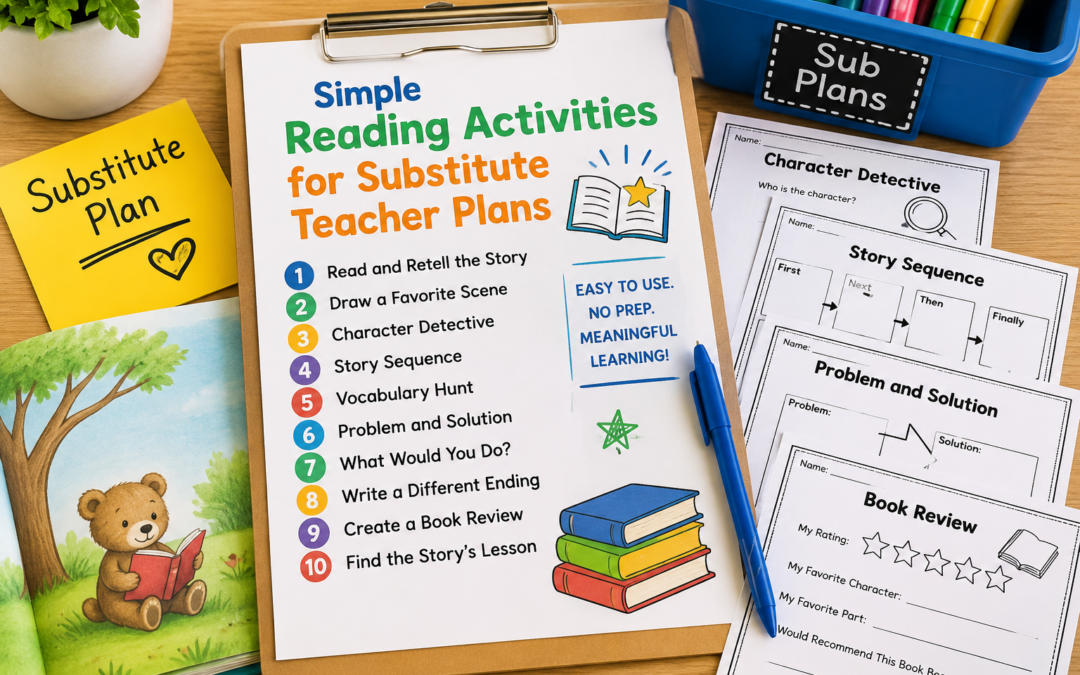
1. Read and Retell the Story
Begin with a read-aloud, independent reading book, or assigned classroom story.
After reading, ask students to retell what happened using the beginning, middle, and end.
Students can respond orally, write a short paragraph, or complete three sections on a worksheet:
Beginning: What happened first?
Middle: What important problem or event occurred?
End: How was the problem solved or how did the story finish?
This activity reinforces sequencing, comprehension, and summarizing without requiring a complicated lesson.
2. Draw a Favorite Scene
A drawing activity is easy for a substitute to manage and gives students a creative way to demonstrate comprehension.
Ask students to draw their favorite scene from the story.
Under the picture, students can complete one or two sentences:
My favorite part was __________.
I liked this part because __________.
Older students can write a short paragraph explaining why the scene was important to the story.
This activity combines reading comprehension, writing, and creativity.
3. Character Detective
Have students choose one character from the book and become a “character detective.”
They can answer questions such as:
- Who is the character?
- What does the character want?
- What problem does the character face?
- How does the character feel?
- What choice does the character make?
- What does the character learn?
Students can also list three words that describe the character and provide evidence from the story.
For example:
Kind — because the character helped a friend.
Brave — because the character tried something difficult.
Responsible — because the character admitted a mistake.
Character activities encourage students to think beyond simple story recall.
4. Story Sequence Activity
Sequencing is another simple literacy skill that works well in substitute plans.
Ask students to identify four or five important events from the story and place them in order.
Students can number the events or create a simple story timeline.
For younger students, use:
First
Next
Then
Finally
For older students, ask them to explain why each event was important.
This activity can work with almost any fiction or narrative text.
5. Vocabulary Hunt
Ask students to find three to five interesting or unfamiliar words in the story.
For each word, students can:
- Write the word.
- Guess what it means based on the story.
- Write the definition.
- Use the word in a new sentence.
- Draw a picture representing the word.
A vocabulary hunt gives students meaningful language practice while keeping the assignment connected to the book they are reading.
6. Problem and Solution Page
Most children’s stories contain some type of problem.
Ask students:
What problem did the character face?
Then have them explain:
How was the problem solved?
Students can complete a simple format:
Problem: ______________________
What the character tried: ______________________
Solution: ______________________
Was it a good solution? Why or why not? ______________________
This activity develops comprehension and problem-solving skills.
7. What Would You Do?
Stories often provide natural opportunities for students to practice decision-making.
Choose an important moment from the story and ask:
What would you do if you were the character?
Students should explain their answer.
For example:
If I were the character, I would __________ because __________.
This activity encourages students to connect literature with their own thinking and experiences.
It can also support conversations about kindness, friendship, responsibility, honesty, courage, and making good choices.
8. Write a Different Ending
Creative writing can be an excellent independent activity for substitute days.
Ask students to imagine that the story ended differently.
They might write about:
- A different choice the character makes
- A new problem that occurs
- A surprise ending
- What happens the next day
- What happens several years later
This gives students an opportunity to demonstrate understanding of the original story while using imagination and writing skills.
9. Create a Book Review
A simple book review can work with almost any reading assignment.
Students can answer:
Book Title: ______________________
My Rating: ★★★★★
My Favorite Character: ______________________
My Favorite Part: ______________________
The Story Was About: ______________________
I Would Recommend This Book Because: ______________________
Book reviews encourage students to form and explain opinions about what they read.
They also give teachers a quick way to see whether students understood the story.
10. Find the Story’s Lesson
Many children’s books contain an important message or theme.
Ask students:
What lesson does this story teach?
Possible themes might include:
- Kindness
- Friendship
- Responsibility
- Courage
- Patience
- Honesty
- Inclusion
- Perseverance
- Helping others
- Making good choices
Students can write:
I think the lesson of this story is __________ because __________.
This activity encourages students to think more deeply about a story’s meaning.
A Simple Substitute Reading Plan
Teachers can combine several of these activities into an easy substitute lesson.
Example 45–60 Minute Reading Plan
10–20 minutes — Read
Students read independently, with a partner, or listen to the substitute read aloud.
10 minutes — Retell
Students complete a beginning, middle, and end activity.
10 minutes — Character Activity
Students describe one character and explain an important choice.
10–15 minutes — Creative Response
Students draw a favorite scene or write a different ending.
5 minutes — Reflection
Students write one sentence explaining the lesson they learned from the story.
The substitute receives a clear plan, students stay productive, and valuable reading skills keep getting reinforced.
Create an Early-Finisher Reading Folder
Teachers can also prepare a small folder of reusable reading activities for substitute days.
Include pages such as:
- Story Comprehension
- Beginning, Middle, and End
- Character Reflection
- Vocabulary Builder
- Draw the Scene
- Main Idea and Lesson
- Problem and Solution
- Book Review
- Creative Writing
- Story Reflection
Because these activities work with many different books, teachers don’t need to create new worksheets every time they are absent.
A reusable reading folder can become a valuable part of your substitute teacher materials.
Keep Substitute Plans Simple
A substitute lesson doesn’t have to introduce complicated new material.
Sometimes the most successful plan lets students practice skills they already understand.
A good children’s book paired with a few familiar activities can provide meaningful practice in:
Reading • Comprehension • Writing • Vocabulary • Sequencing • Critical Thinking • Creativity • Character Education
Clear directions also help the substitute spend less time explaining and more time helping students stay focused.
Reading Resources for Teachers at ScottMBooks.com
At ScottMBooks.com, teachers can find children’s stories and reading activities to incorporate into regular classroom lessons, literacy centers, independent work, enrichment activities, and substitute teacher plans.
A story can become much more than something students simply read.
With a few thoughtful questions and activities, one book can provide an entire literacy lesson.
When preparing your next substitute folder, consider including a few flexible reading activities that can be used with almost any children’s book.
Simple plans can still create meaningful learning.