5 Activities to Use After Reading Any Children’s Book
Finishing a children’s book does not have to mean the learning is over. In fact, some of the best reading practice can happen after the final page.
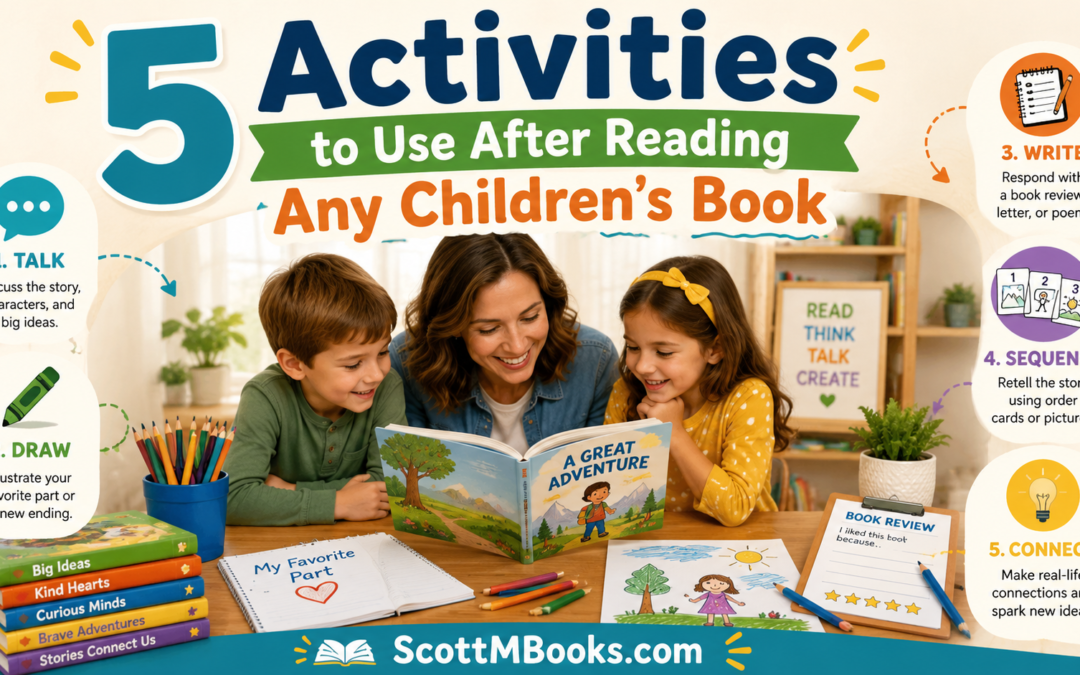
A few simple follow-up activities can help children strengthen reading comprehension, vocabulary, sequencing, writing, critical thinking, creativity, and character development. These activities can be used by parents, teachers, and homeschool families with almost any children’s story.
The key is to keep the activities simple, enjoyable, and connected to what the child just read.
1. Retell the Story: Beginning, Middle, and End
One of the easiest ways to check reading comprehension is to ask a child to retell the story.
Instead of asking them to remember every detail, divide the story into three parts:
Beginning: What happened first?
Middle: What was the biggest problem or important event?
End: How was the problem solved, and how did the story finish?
Younger children can answer these questions aloud or draw three pictures. Older children can write one or two sentences for each part.
This activity helps children recognize which events are most important and understand how a story is organized.
You can make the activity even easier by using the words:
First… Then… Finally…
For example:
First, the character discovered a problem.
Then, the character tried to solve it.
Finally, the problem was resolved and the character learned something.
Retelling strengthens both comprehension and memory.
2. Explore a Character’s Feelings and Traits
Characters provide an excellent way to help children think more deeply about a story.
Start by asking:
“How did the main character feel?”
Then ask why.
Was the character worried because something went wrong? Proud because they solved a problem? Nervous about trying something new? Happy because a friend helped?
Next, explore character traits.
Ask the child to choose words such as:
kind, brave, patient, responsible, helpful, curious, determined, thoughtful, or honest.
The most important follow-up question is:
“What happened in the story that makes you think that?”
This encourages children to support their ideas with evidence.
Instead of simply saying, “The character was kind,” a child learns to explain:
“The character was kind because she helped another student who was feeling left out.”
That is an important step toward deeper reading comprehension.
3. Draw a Favorite Scene
Not every reading activity needs to involve a lot of writing.
Ask children to choose their favorite scene—or an important moment from the story—and draw it.
Once the picture is finished, ask them to write one sentence:
“My picture shows ______________________________.”
Then add another:
“This part was important because ______________________________.”
Drawing can be especially helpful for younger children who understand the story but may not yet be comfortable writing long answers.
The picture also gives parents and teachers something concrete to discuss.
Ask:
Who is in your picture?
What is happening?
How does the character feel?
Why did you choose this part?
A simple drawing activity can reveal a great deal about what a child understood.
4. Find the Problem, Solution, and Lesson
Most children’s stories contain some type of problem.
Maybe a character loses something, has a disagreement, feels afraid, makes a mistake, faces a challenge, or needs to help someone.
After reading, ask three questions:
What was the problem?
What did the character do about it?
How was the problem solved?
Then go one step further:
“What did the character learn?”
This helps children understand that stories are not simply a collection of events. Characters often grow or change because of what happens.
The story’s lesson might involve kindness, responsibility, courage, friendship, patience, honesty, inclusion, perseverance, or making good choices.
You can also ask:
“Could this lesson help you in real life?”
That question helps children connect literature with their own experiences.
For example, if a character learns to ask for help, you might ask:
“When would asking for help be a good choice for you?”
If a character learns to forgive a mistake:
“What should we do when someone makes an honest mistake?”
Stories can become natural starting points for important conversations.
5. Create Something New From the Story
Once children understand the original story, let them use their imagination.
They could create a different ending, write about what happens the next day, invent a new character, design a new book cover, write a letter to a character, or imagine what they would do if they were part of the story.
A simple prompt might be:
“If I were the character, I would…”
Or:
“I would change the ending by…”
Another fun choice is to ask children to create one new page for the book.
What would happen next?
What would the character say?
What would the illustration show?
Creative responses encourage children to use what they understood about the characters and events while practicing writing and imagination.
You Don’t Need to Use All Five Activities
One of the most important things to remember is that reading activities should support enjoyment—not replace it.
You do not need to complete five worksheets after every story.
Choose one activity.
One day, simply talk about the character.
Another day, draw a scene.
Another time, discuss the problem and solution.
You might spend five minutes asking questions after one book and twenty minutes creating a new ending after another.
The activity should fit the child, the book, and the time you have available.
Create a Simple After-Reading Routine
Families and classrooms can also use a simple routine after finishing a book.
Start with one question:
“What happened?”
Then ask:
“What did the character learn?”
Finish with:
“What did you think about the story?”
Those three questions alone can encourage children to summarize, identify a lesson, and express an opinion.
That is valuable reading practice without making story time feel complicated.
Use ScottMBooks Reading Activities
At ScottMBooks.com, stories can be paired with reading activities that help children continue learning after they finish reading.
Resources can include activities such as Story Comprehension Questions, Character Feelings, Sequence the Story, Main Idea and Story Lesson, Vocabulary Builders, Character Traits, Problem and Solution, Cause and Effect, Story Maps, Draw the Scene, Writing Prompts, Book Reviews, and Character-Building Activities.
These resources are designed to help teachers, homeschool families, and parents turn children’s stories into opportunities for reading practice, discussion, creativity, and character development.
You can choose the activity that fits your child or student rather than trying to complete everything at once.
The Best Reading Activities Start With Conversation
Children do not need complicated lessons after every story.
Sometimes the most valuable activity is simply talking.
Ask what they liked.
Ask what surprised them.
Ask how the character felt.
Ask what they would have done differently.
Listen to their answers.
When children learn that reading is not only about saying words correctly but also about thinking, questioning, imagining, and connecting ideas, they begin developing the habits of strong readers.
A good children’s book can provide much more than a story.
It can inspire a conversation.
A drawing.
A writing idea.
A lesson about kindness.
A new vocabulary word.
Or a different way of looking at a problem.
Read the story. Talk about it. Create something from it. And help the learning continue long after the final page.