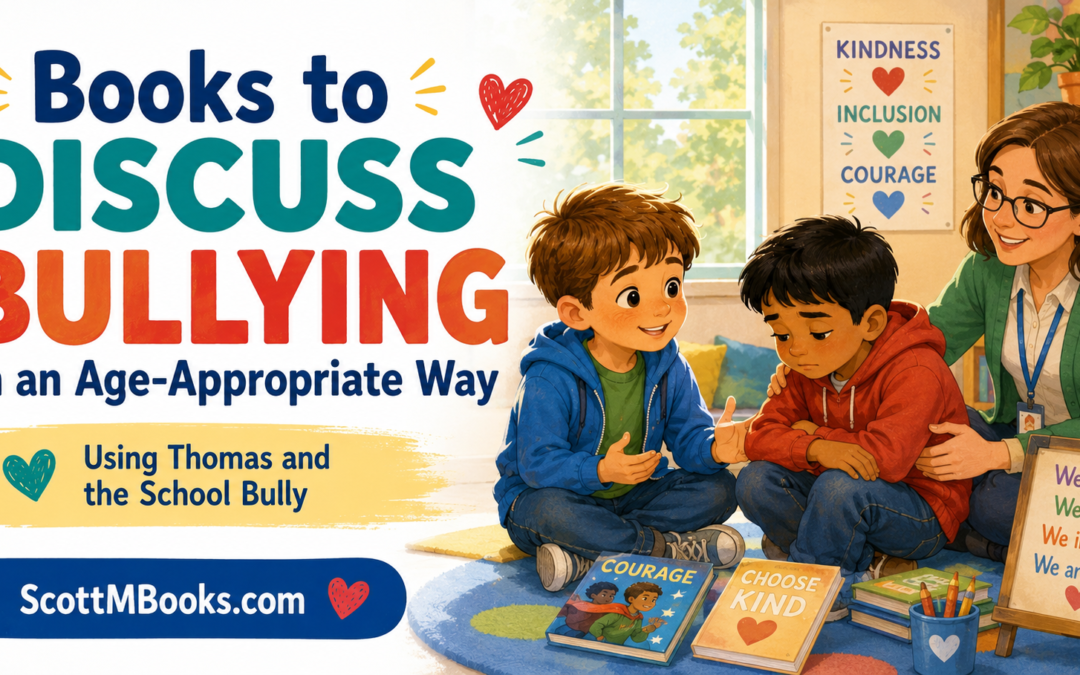
Books to Discuss Bullying in an Age-Appropriate Way
Bullying can be a difficult subject to discuss with children. Parents and teachers want children to understand that teasing, exclusion, name-calling, and other hurtful behavior are unacceptable. Still, they also want those conversations to feel safe, understandable, and age-appropriate.
Children’s books can help.
A story gives children a little distance from a difficult subject. Instead of beginning with, “Has anyone ever bullied you?” an adult can begin with a character: “How do you think Thomas felt when that happened?”
That small difference can make a big conversation easier.
At ScottMBooks.com, we created Thomas and the School Bully around that idea. The story explores bullying through situations children can recognize while emphasizing courage, kindness, asking for help, standing up for others, and understanding that every child deserves to feel safe and accepted at school.
Why Stories Can Help Children Talk About Bullying
Children may not always have the words to explain an uncomfortable experience.
They may know that something made them feel bad but not understand whether it was teasing, conflict, exclusion, or bullying. Others may have witnessed a classmate being treated poorly and wondered whether they should get involved.
Books give children examples they can examine without having to talk about themselves right away.
While reading, adults can pause and ask:
Was that behavior kind or unkind?
How did it make the character feel?
What could the character do next?
Who could help?
The discussion starts with the story. If a child later wants to connect it to something in real life, the conversation can naturally go there.
Thomas Encounters Hurtful Behavior
In Thomas and the School Bully, the problem begins in a way many children can understand.
On the playground, Max makes fun of Thomas’s backpack and deliberately bumps into him. Thomas is surprised and does not know what to say. The experience leaves him with a quiet but very real feeling of hurt and confusion.
This kind of scene can help adults explain that hurtful behavior does not have to involve a dramatic fight to matter.
Words can hurt.
Exclusion can hurt.
Embarrassing someone in front of other children can hurt.
That is an important message for younger readers because bullying is sometimes portrayed only as physical aggression. A story can help children recognize that repeated cruel words and social behavior deserve attention too.
Help Children Name the Feelings
One useful way to discuss bullying is to start with feelings.
Thomas feels nervous, embarrassed, uncertain, and small around someone who is treating him badly.
Ask a child:
“What do you think Thomas was feeling?”
Then follow with:
“What happened that made him feel that way?”
This teaches children to connect actions with emotional consequences.
It also builds empathy.
Children begin understanding that something one person thinks is “just a joke” may not feel funny to the person receiving it.
Show Children That They Are Not Alone
One meaningful moment in Thomas’s story occurs when he sees Max teasing another child, Eli.
Eli is mocked for carrying a book and then sits alone near the edge of the playground. Thomas recognizes the same hurt he has experienced. Instead of ignoring Eli, he walks over, sits beside him, starts a conversation, and eventually invites him to join him after recess.
This creates an excellent discussion about bystanders.
Children do not always need to confront another student directly to make a difference.
Sometimes helping means sitting beside someone who is alone.
Sometimes it means including them.
Sometimes it means telling an adult.
Sometimes it simply means making sure the child being targeted knows someone cares.
These are concrete actions young readers can understand.
Teach That Asking an Adult for Help Is a Strong Choice
Children sometimes worry that telling an adult will make them look weak or get them labeled as a “tattletale.”
Stories can help challenge that idea.
Thomas and the School Bully includes a chapter called “Talking to Someone Who Helps,” and later Thomas reflects that talking with his teacher made him feel lighter. His teacher helps him understand that standing up for himself does not require being mean in return.
That distinction matters.
Children should know that there is a difference between trying to get someone in trouble over something minor and asking for help because someone is repeatedly being hurt, threatened, frightened, humiliated, or excluded.
Adults can reinforce a simple message:
If someone is hurting you or another child and you do not know how to make it stop safely, tell a trusted adult.
Standing Up Does Not Mean Fighting Back
Children sometimes imagine “standing up to a bully” as shouting, pushing back, or winning a confrontation.
Thomas learns another approach.
When Max again calls him a name, Thomas responds calmly and directly:
“Please stop.”
He tells Max that he does not like being called names. His response is not loud or aggressive, but it is firm.
That moment is a good opportunity to talk about assertiveness.
Assertiveness is different from aggression.
A child can communicate:
Stop.
I don’t like that.
That isn’t okay.
And if the behavior continues—or if speaking directly does not feel safe—the child should seek help from a responsible adult.
The goal should never be to make a child feel responsible for personally stopping bullying.
Safety comes first.
Talk About the Difference Between Conflict and Bullying
Not every disagreement between children is bullying.
Friends argue.
Children become frustrated.
Someone may say something unkind once and later apologize.
Bullying usually involves a pattern of harmful behavior and often includes an imbalance of power, whether that comes from physical size, social status, group pressure, intimidation, or another factor.
Children do not need a complicated definition, but they can begin learning to ask:
Is this happening again and again?
Is someone trying to hurt or embarrass another person?
Does the child feel afraid or unable to make it stop?
Does someone need adult help?
Books can provide examples for practicing those distinctions without putting a child on the spot.
Help Children Think About What a Bystander Can Do
A particularly useful conversation is not only:
“What should you do if someone bullies you?”
but also:
“What could you do if you saw it happening to someone else?”
A child might safely get a teacher.
Invite the excluded child to join a game.
Sit beside someone who is alone.
Refuse to laugh at a cruel joke.
Tell a friend, “That wasn’t kind.”
Ask the child afterward if they are okay.
Thomas’s decision to sit with Eli demonstrates that even a small act of inclusion can change how another child experiences a difficult moment.
Discuss the Person Bullying Without Excusing the Behavior
One of the more nuanced lessons in Thomas and the School Bully comes later in the story.
Thomas notices that Max is struggling too. His teacher explains that people who hurt others may sometimes be hurting themselves—but she is equally clear that this does not make bullying acceptable and that everyone remains responsible for treating others with respect.
This distinction matters when discussing bullying with children.
Understanding someone is not the same as excusing what they did.
Children can learn both ideas at the same time:
What Max did was wrong.
And:
Max is still a person who may need help learning to behave differently.
Thomas ultimately learns that he can stand up for what is right while still caring about people. The story describes kindness not as letting someone keep hurting others, but as believing people can learn to make better choices.
That is a valuable lesson in compassion with boundaries.
Questions to Ask After Reading
After reading a book about bullying, adults do not need to deliver a long lecture. A few thoughtful questions are often more useful:
- How did Thomas know that Max’s behavior was hurting him?
- Why do you think Eli sat by himself?
- What did Thomas do that helped Eli feel less alone?
- Why was talking with a teacher a good choice?
- What is the difference between standing up for yourself and being mean back?
- What could you safely do if you saw someone being picked on?
- Why doesn’t understanding Max’s feelings make his bullying okay?
- What does the story teach about courage?
- What does it teach about kindness?
- Who are the trusted adults you could talk to if you or a friend needed help?
The last question is especially valuable. Children should be able to identify specific people they can approach before a problem happens.
Use Reading Activities to Continue the Conversation
A story about bullying can also become the starting point for literacy and character-building activities.
After reading, children might complete a Character Feelings Page showing how Thomas feels at different points in the story.
They could create a Problem and Solution Page explaining what Thomas tries and who helps him.
A Character Traits Activity could explore words such as brave, kind, helpful, responsible, patient, and understanding.
Students could also write about:
“What would I do if I saw someone sitting alone after being teased?”
Or create a poster with a message such as:
Everyone Belongs Here.
Stand Up for Each Other.
Be Kind.
Those ideas echo the schoolwide messages that appear near the end of Thomas’s story, where students create kindness posters and the playground gradually becomes safer and more welcoming.
Let the Conversation Continue After the Book
One discussion about bullying is rarely enough.
Children benefit from knowing that the subject is always safe to bring up.
Parents and teachers can occasionally ask:
“How are things going with the other kids?”
“Does everyone seem to have someone to play with?”
“Have you noticed anyone being left out?”
These questions are often easier to answer than immediately asking, “Are you being bullied?”
They also show children that adults care about the social side of school, not only grades and assignments.
Books Can Give Children Words for Difficult Situations
The best age-appropriate books about bullying do not need to frighten children or make every problem seem enormous.
They can show recognizable situations.
They can help children name feelings.
They can model asking for help.
They can demonstrate safe choices.
They can show the power of inclusion.
And they can remind children that kindness does not mean staying silent when someone is being hurt.
In Thomas and the School Bully, Thomas begins the story feeling small and unsure, but the larger message is about the quiet courage to speak up, seek help, include another child, and choose kindness. The story eventually shows how those small choices can spread through a school community.
At ScottMBooks.com, stories can be used not only to strengthen reading skills, but also to begin conversations about the situations children encounter in everyday life.
A story cannot solve bullying on its own.
But it can give a child something very important:
Words to describe what is happening.
Confidence to ask for help.
Ideas for supporting someone else.
And the understanding that every child deserves to feel safe, respected, and included.