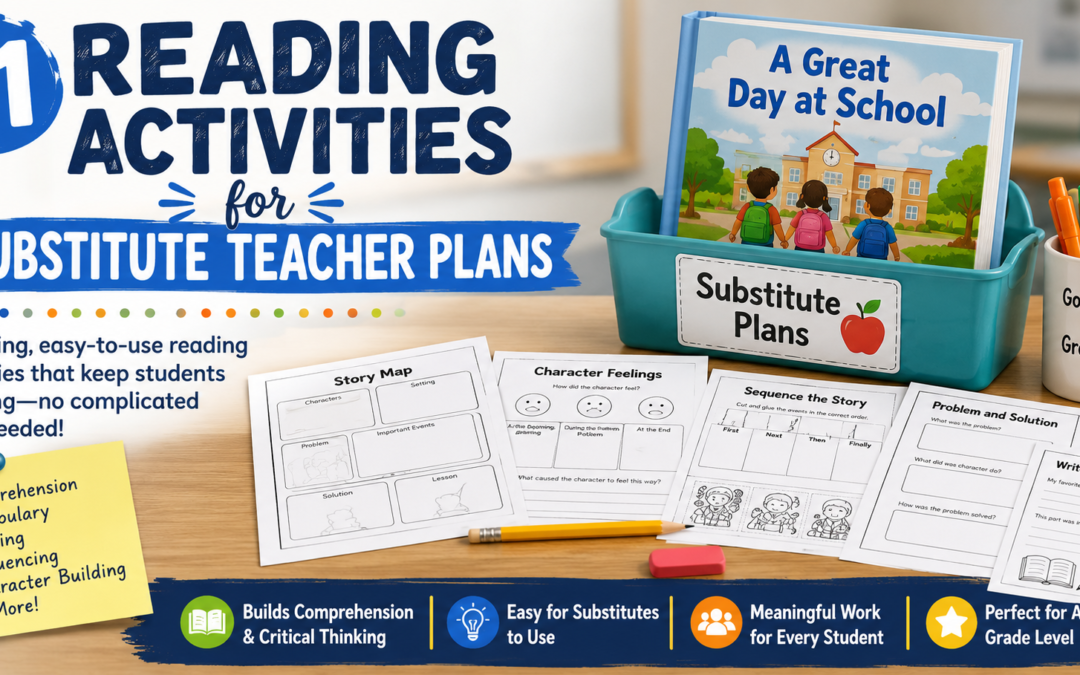
Reading Activities for Substitute Teacher Plans
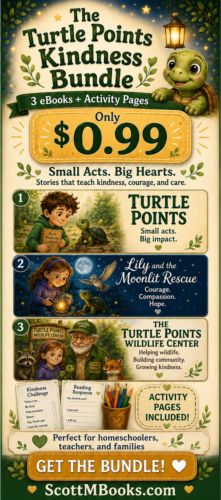
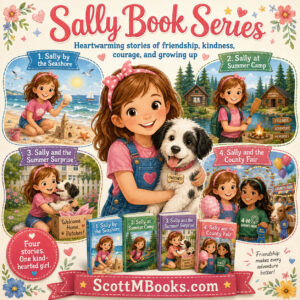
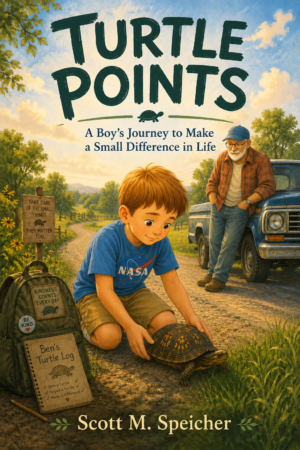
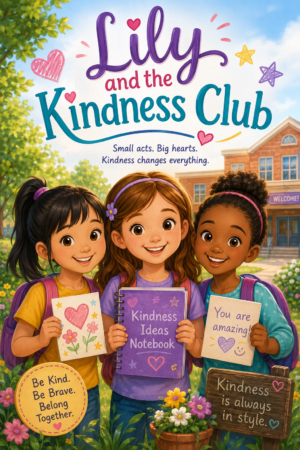
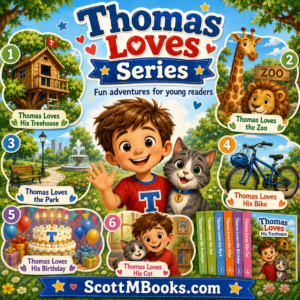
To be used with my FREE eBooks for Children. ScottMBooks.com/book-shelf
Preparing for a substitute tehttp://ScottMBooks.comacher can be challenging. Teachers want students to stay productive, practice important skills, and complete meaningful work—but substitute plans also need to be simple enough for another adult to understand and use without a lengthy explanation.
Reading activities are a great solution.
A good children’s story can support an entire class period, literacy block, or even several short assignments. With a few ready-to-use activities, substitute teachers can guide students through comprehension, vocabulary, writing, sequencing, creativity, and character development without introducing a complicated new lesson.
At ScottMBooks.com, children’s stories and printable reading activities can be used as flexible resources for regular classroom instruction, independent work, literacy centers, and substitute teacher plans.
Why Reading Activities Work Well for Substitute Plans
Substitute lessons work best when directions are clear and students can complete much of the work independently.
Reading activities are especially useful because they can often follow a familiar structure:
Read the story.
Think about what happened.
Answer a few questions.
Complete one response activity.
That structure gives students something purposeful to do while making the lesson easier for a substitute teacher to manage.
Reading activities can also reinforce skills students are already learning instead of requiring the substitute to introduce unfamiliar material.
Students can practice:
- Reading comprehension
- Story sequencing
- Main idea
- Character traits
- Character feelings
- Vocabulary
- Problem and solution
- Cause and effect
- Writing
- Creative thinking
- Character education
The result is a substitute plan that feels connected to learning rather than simply filling time.
1. Start With a Read-Aloud or Independent Story
The easiest place to begin is with one children’s book.
Depending on the grade level, the substitute can:
- Read the story aloud to the class.
- Have students read independently.
- Let students read with a partner.
- Use an already familiar class book.
- Use one of the children’s stories available through ScottMBooks.
Before reading, include a few simple instructions for the substitute.
For example:
Before reading, ask students to look at the title and cover and predict what they think will happen.
Then the substitute can read the story with minimal additional preparation.
2. Use a Before You Read Activity
A short prediction activity gives students something to think about before the story begins.
Students might answer:
What do you think the story will be about?
Who do you think the main character will be?
What problem might happen?
Where do you think the story takes place?
Younger students can draw their prediction instead of writing several sentences.
This is an easy substitute activity because there are no complicated right or wrong answers.
The goal is simply to get students thinking.
3. Add Story Comprehension Questions
After reading, comprehension questions can help students show what they understood.
Keep the questions clear and age-appropriate.
For younger readers, questions might include:
Who was the main character?
Where did the story happen?
What problem happened?
What did the character do?
How was the problem solved?
What was your favorite part?
Multiple-choice questions can work especially well for substitute plans because students can complete them independently.
A few short-answer questions can then encourage deeper thinking.
4. Sequence the Story
Sequencing is another excellent low-preparation activity.
Ask students to put important events in order.
Use:
First
Next
Then
Finally
For younger students, provide four events and have them number them from 1 to 4.
Older students can write their own summary.
A substitute teacher can easily review this activity with the whole class afterward.
5. Complete a Character Feelings Page
Character feelings activities combine reading comprehension with social-emotional learning.
Ask students to identify how the main character felt:
At the beginning
During the problem
At the end
Then ask:
What caused the character to feel that way?
Students might choose from feeling words such as:
worried • excited • frustrated • proud • nervous • relieved • happy
This type of activity works particularly well with stories involving everyday challenges, friendships, mistakes, responsibility, or problem-solving.
6. Explore Character Traits
Another easy substitute activity is a character traits page.
Students choose words that describe the main character.
Examples include:
Kind
Brave
Responsible
Patient
Helpful
Honest
Determined
Understanding
Then ask students to provide one example from the story.
For example:
The character was determined because ________________________.
This encourages students to support their ideas with story evidence.
7. Use a Problem and Solution Page
Most children’s stories include a central problem.
Students can complete a simple three-part organizer:
The Problem
What went wrong?
What the Character Did
How did the character respond?
The Solution
How was the problem solved?
For an additional challenge, ask:
Was this a good solution? Why or why not?
Problem-and-solution activities are particularly useful for substitute plans because they require very little explanation.
8. Include a Vocabulary Builder
Choose three to five important words from the story.
Students can:
- Write the word.
- Match it to a definition.
- Use it in a sentence.
- Draw a picture showing what it means.
Keep vocabulary assignments short for younger students.
A three-word activity can provide meaningful practice without becoming overwhelming.
9. Draw the Scene
Creative activities are especially useful when substitute plans include younger students.
Ask students to draw:
Their favorite scene
or
The most important moment in the story
Then have them complete:
My picture shows __________________________________________.
Students can also write:
This scene is important because _____________________________.
This gives students an opportunity to demonstrate comprehension without requiring a long written response.
10. Write About the Story
A simple writing prompt can turn the story into language arts practice.
Try:
What was your favorite part and why?
What would you do if you were the main character?
What advice would you give the character?
What do you think happens next?
What lesson did the character learn?
For Grades 1–2, one or two sentences may be enough.
Older students can write a paragraph.
11. Create a New Ending
Students often enjoy changing a story.
Ask:
What if the story ended differently?
Students can write or draw their new ending.
They might change:
- The character’s choice
- The solution
- The setting
- The final event
- The lesson
This is an excellent early-finisher activity because students can continue adding detail without needing additional directions.
12. Complete a Story Map
A story map can combine several reading skills on one page.
Students identify:
Title
Characters
Setting
Problem
Important Events
Solution
Lesson
This makes a strong stand-alone substitute assignment because it provides a complete review of the story.
13. Find the Main Idea and Story Lesson
After students understand what happened, ask them what the story was really about.
Try:
The story is mostly about ________________________________.
Then:
The story teaches us ____________________________________.
Possible lessons might include:
- Be kind.
- Ask for help.
- Keep trying.
- Include others.
- Tell the truth.
- Take responsibility.
- Be patient.
- Learn from mistakes.
Students can then explain which part of the story supports their answer.
14. Add a Cause and Effect Activity
Cause and effect helps students understand how one event leads to another.
For example:
Cause: The character forgot something.
Effect: _________________________________________________
Or:
Cause: The character asked for help.
Effect: _________________________________________________
These can be completed independently and reviewed quickly.
15. Finish With a Book Review
A book review provides an easy end-of-lesson activity.
Students can complete:
My Rating: ★★★★★
My Favorite Part: _______________________________________
The Story Taught Me: ____________________________________
I Would / Would Not Recommend This Book Because:
Book reviews allow students to practice expressing an opinion and supporting it with a reason.
A Simple Substitute Reading Plan
You can make substitute planning easier by preparing a reusable structure.
For example:
Reading Block
Step 1: Read the assigned story.
Step 2: Complete Story Comprehension Questions.
Step 3: Complete one activity:
- Character Feelings
- Sequence the Story
- Problem and Solution
- Story Map
Step 4: Draw a favorite scene or complete a writing prompt.
Step 5: Early finishers complete a book review or create a new ending.
This gives the substitute enough material to keep students engaged while still providing flexibility.
Create a Substitute Reading Folder
Teachers can save time by preparing a folder with generic reading pages that work with almost any book.
Include several copies of:
Before You Read
Story Comprehension
Sequence the Story
Character Feelings
Character Traits
Problem and Solution
Vocabulary Builder
Cause and Effect
Story Map
Draw the Scene
Write About the Story
Book Review
Then, when a substitute is needed, you only need to choose a book.
This can save significant preparation time during an already stressful absence.
Include Clear Notes for the Substitute Teacher
A good substitute plan should not assume the substitute knows your usual classroom routines.
Keep directions short.
For example:
Read the story aloud. Students should listen from their seats.
After reading, distribute the comprehension page.
Students may work independently.
When finished, students may complete the Draw the Scene page.
Early finishers may read quietly.
Clear directions reduce confusion for both the substitute and the students.
Use ScottMBooks as a Substitute-Plan Resource
ScottMBooks.com can provide teachers with children’s stories and reading activities that can fit naturally into substitute teacher plans.
Activities can reinforce skills such as:
Reading Comprehension • Vocabulary • Sequencing • Main Idea • Character Traits • Feelings • Problem and Solution • Cause and Effect • Writing • Creativity
ScottMBooks stories can also open conversations about:
Kindness • Courage • Responsibility • Friendship • Patience • Inclusion • Helping Others • Making Good Choices
Because many of the activities follow familiar literacy formats, teachers can select a few pages that fit the amount of time available.
You do not need to use an entire activity pack.
One story and two or three well-chosen activities may be enough for a productive reading lesson.
Prepare Once and Reuse
One of the best ways to make substitute planning easier is to prepare reusable literacy resources before you need them.
A story.
A comprehension sheet.
A story map.
A writing or drawing activity.
An early-finisher page.
That simple combination can become a dependable substitute lesson you can use again with different books.
Meaningful Work Without Complicated Preparation
Substitute teacher plans do not need to introduce complicated new concepts to be valuable.
Students can strengthen important skills by reading a good story and responding thoughtfully to it.
They can:
Read.
Remember.
Think.
Write.
Draw.
Discuss.
Reflect.
With a few ready-to-use reading activities and resources from ScottMBooks.com, a substitute day can remain structured, educational, and enjoyable for students—while making preparation much easier for teachers.
Simple plans. Meaningful reading. Productive learning—even when the regular teacher is away.